
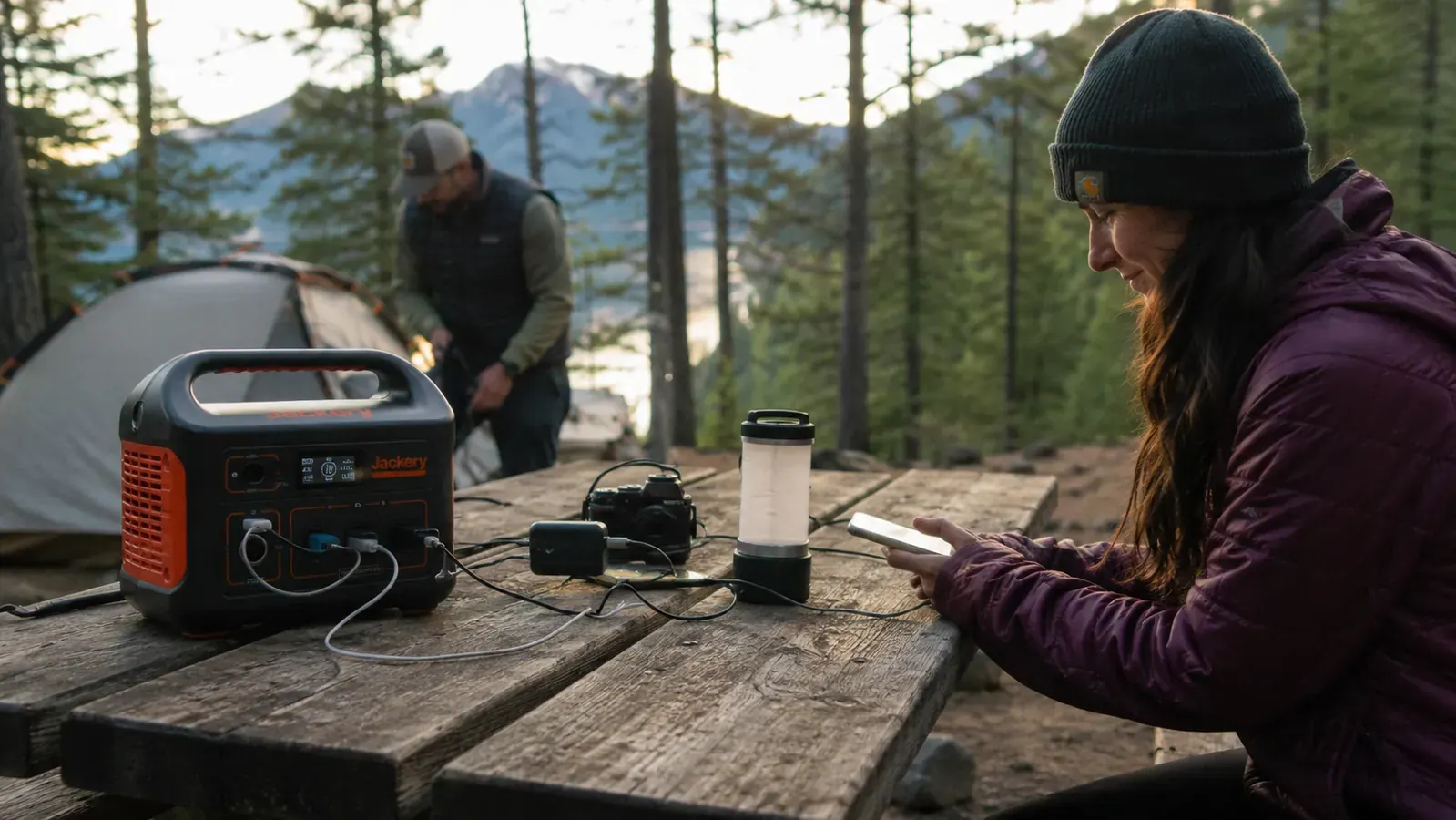
If you have been camping for more than a season, you have probably stared at both of these options and wondered whether the extra $50 for a Goal Zero is actually worth it. Short answer: it is not. The Jackery Explorer 300 gives you 292Wh of usable capacity for around $199. The Goal Zero Yeti 200X gives you 187Wh for around $250. That is 56 percent more stored electricity for less money. I have run the Jackery Explorer 300 on everything from CPAP machines to mini fans to group phone charging, and it has not let me down on a single trip.
That said, the Goal Zero Yeti 200X is not a bad unit. It is lighter, Goal Zero has strong support infrastructure, and if you are already deep in the Goal Zero ecosystem, the upgrade path is smoother. But for a camper who wants the most reliable, highest-capacity portable power for the least money, the Jackery wins this comparison clearly. Here is the full breakdown.
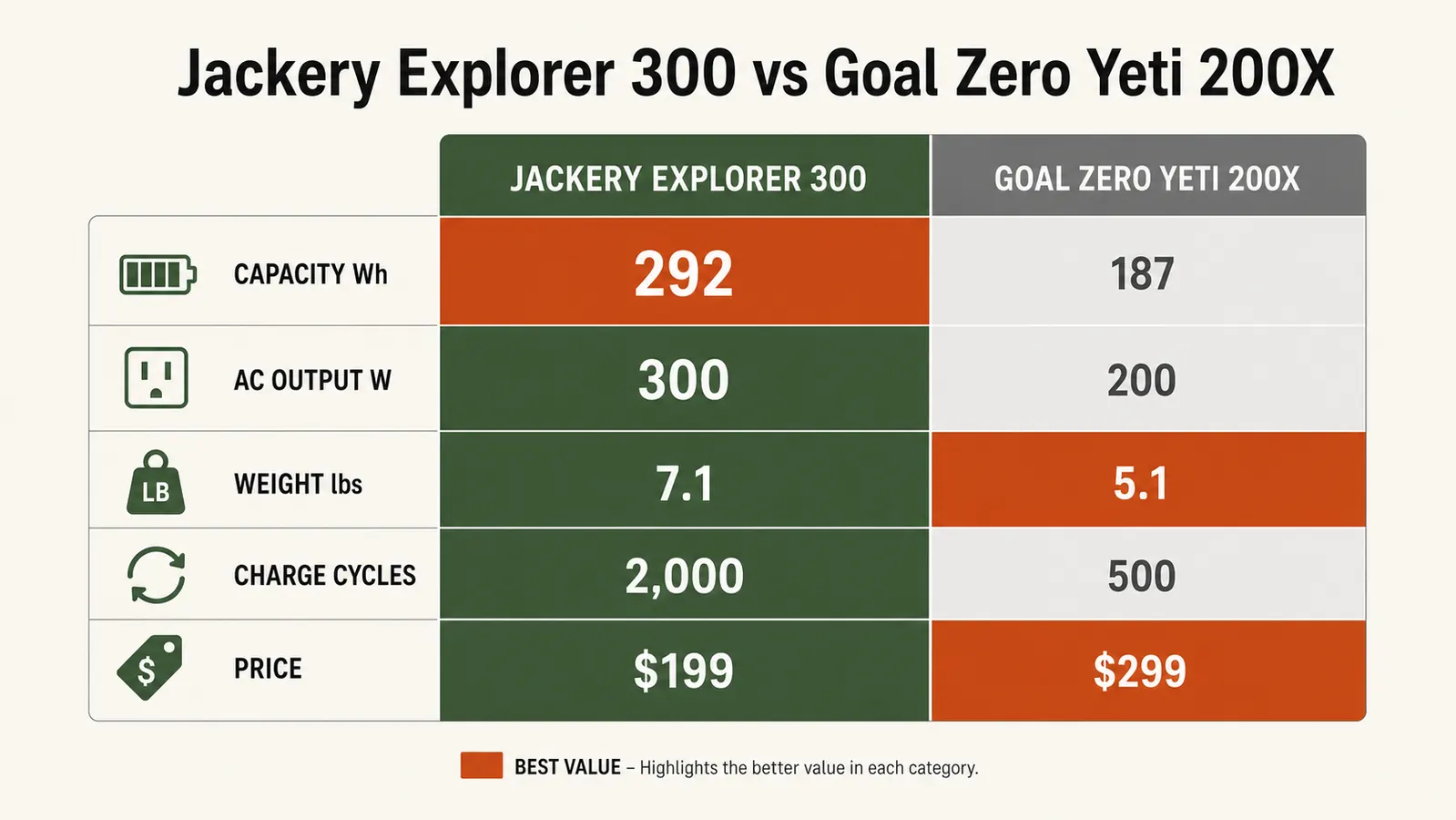
| Jackery Explorer 300 | Goal Zero Yeti 200X | |
|---|---|---|
| Capacity | 292Wh | 187Wh |
| AC Output (peak) | 300W (600W surge) | 200W (400W surge) |
| Battery Chemistry | LiFePO4 (iron phosphate) | NMC Lithium |
| Estimated Cycle Life | 500+ cycles to 80% capacity | 300-400 cycles to 80% capacity |
| Weight | 6.1 lbs | 5.0 lbs |
| DC Input (solar max) | 200W max solar input | 120W max solar input |
| USB Ports | 2x USB-A, 1x USB-C (60W PD) | 2x USB-A, 1x USB-C (18W PD) |
| Current Price | ~$199 | ~$250 |
| App / Connectivity | No app (LCD display only) | Bluetooth app monitoring |
56% more capacity, $50 less money. The math is not complicated.
The Jackery Explorer 300 is the straightforward pick for weekend campers who want reliable off-grid power without overpaying for brand prestige. Over 11,000 verified reviews back that up.
Amazon Check Today's Price on Amazon →Where the Jackery Explorer 300 Wins
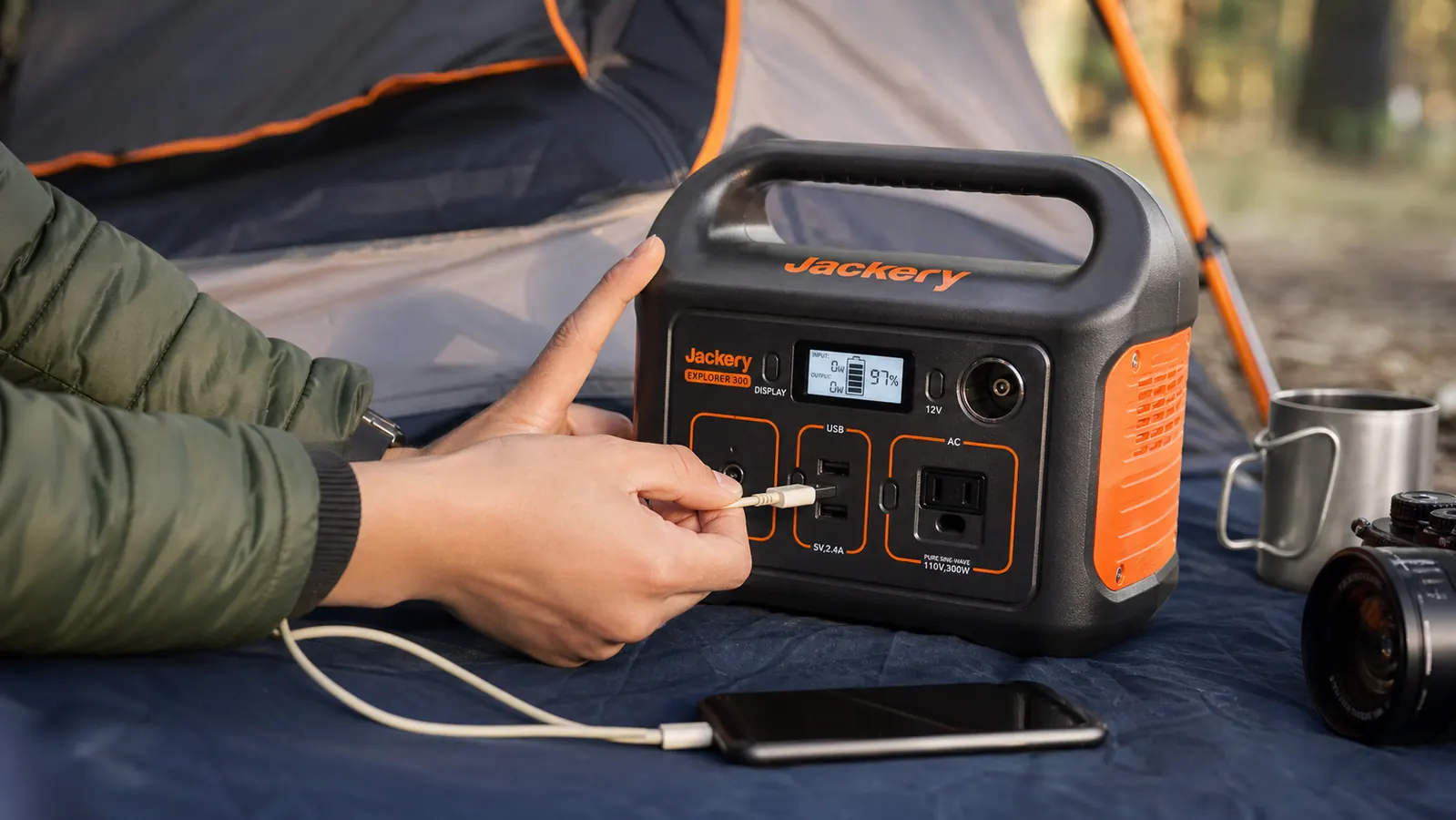
Capacity is the most important spec in a camping power station, and the Jackery wins it by a wide margin. The Explorer 300 holds 292Wh versus the Yeti 200X's 187Wh. To put that in camping terms: a CPAP machine running at roughly 30W draws the Jackery down over 8 hours of continuous use. The Goal Zero would be closer to 5 hours before you hit the 80% discharge threshold. For a two-night trip, that difference matters every single morning.
The battery chemistry also favors the Jackery. LiFePO4 (lithium iron phosphate) is a more stable chemistry than the NMC lithium in the Yeti 200X. It runs cooler, handles more charge cycles before degrading, and has a better safety profile in sustained heat, which matters on a summer camping trip where your gear might sit in a warm car for hours. The Jackery's cell chemistry is closer to what you find in much more expensive power stations.
Then there is the USB-C output. The Jackery Explorer 300 delivers 60W PD on its USB-C port. The Yeti 200X delivers 18W. If you carry a modern laptop, a 60W port can actually keep it from draining while in use. The Yeti's 18W port will slow-charge a laptop at best. For anyone who works remotely and camps on weekends, that gap is real.
The Jackery also accepts up to 200W of solar input versus 120W for the Yeti. If you pair it with a 100W solar panel on a clear day, you can substantially recharge the Jackery in under two and a half hours of direct sun. That changes the math for multi-day trips where you are not near a wall outlet between nights.
292Wh for $199 versus 187Wh for $250. You are paying more to get less. The Goal Zero name is good but it is not that good.
Where the Goal Zero Yeti 200X Wins
The Yeti 200X is about a pound lighter at 5.0 lbs versus the Jackery's 6.1 lbs. For backpackers that might matter. For car campers throwing gear in a trunk, it is not a meaningful difference on a weekend trip. Still, if you carry your power station in a pack rather than a car, the weight gap is real.
Goal Zero also has a Bluetooth app that lets you monitor charge level, wattage draw, and estimated runtime from your phone. The Jackery Explorer 300 has a basic LCD display and nothing else. If you want to geek out on load management or integrate with the Goal Zero ecosystem of panels and accessories, the software layer on the Yeti is genuinely better. Goal Zero's ecosystem is broader, and if you already own Goal Zero solar panels or a Yeti Link expansion battery, the 200X slots in cleanly. The Jackery is a standalone unit with no accessory expansion path beyond the solar input.
Real-World Weekend Use
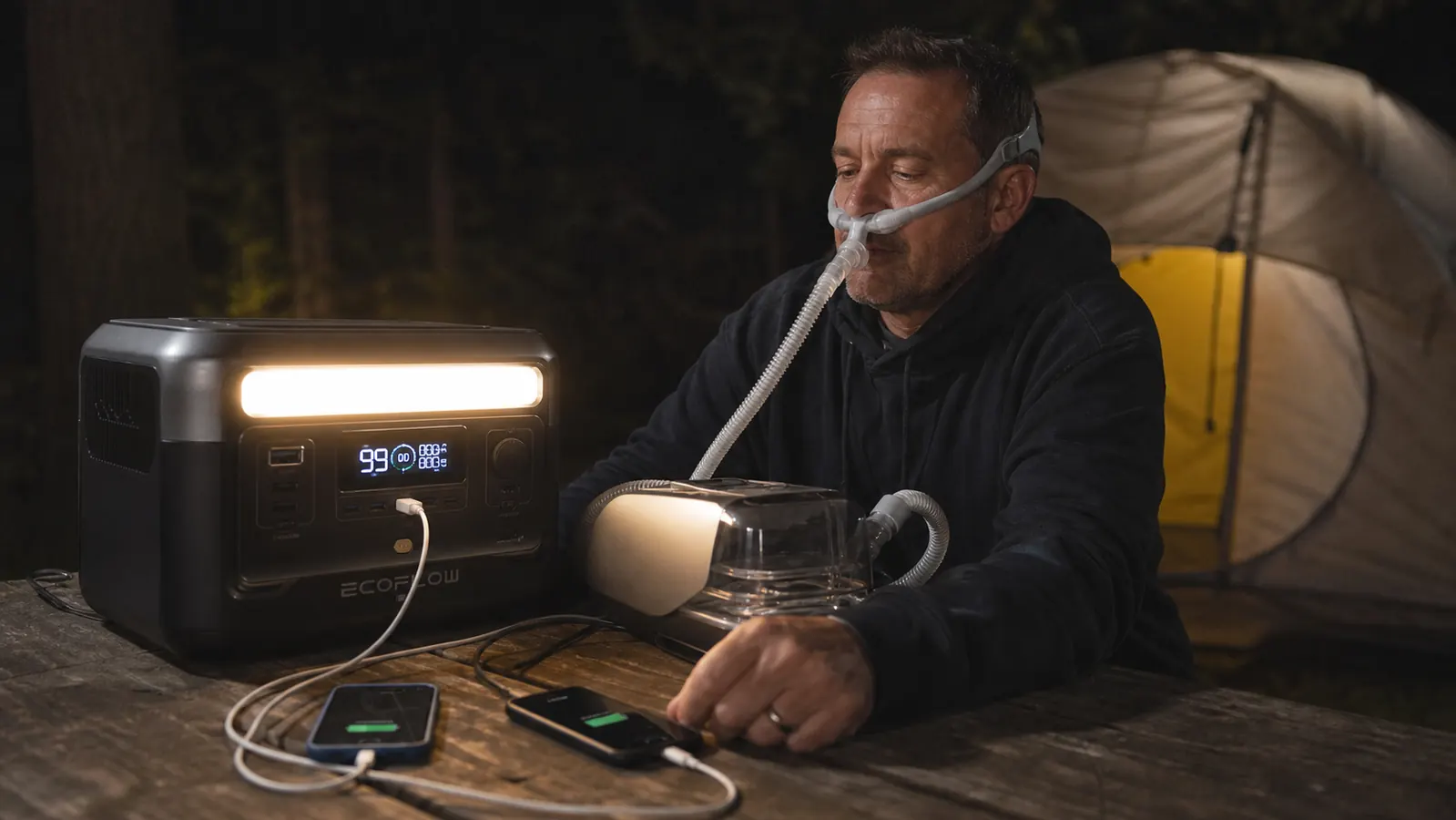
On a typical two-night car camping trip with three people, I run the following off the Jackery Explorer 300: four full phone charges per night, a small LED camp lantern for three to four hours, a mini fan on low for sleeping, and occasionally a battery-powered CPAP for one member of the group. Over 48 hours, that comes to roughly 180-210Wh of actual draw. The Explorer 300 handles that comfortably and still has reserve capacity when we break camp. The Yeti 200X at 187Wh would be running on empty by the second morning under the same load.
The Jackery's AC outlet is rated for 300W continuous with a 600W surge, which means it handles a small camp blender, a travel kettle, or a CPAP without tripping out. The Yeti 200X is rated at 200W continuous, which is enough for most small devices but will reject anything that pulls more on startup. If you ever use a higher-draw appliance, even briefly, the Jackery has more headroom.
One thing I will note: neither unit is silent. Both have small cooling fans that kick on under load. Neither is loud, but if you are a light sleeper running a CPAP in a tent, you will hear the fan cycle. It is not a dealbreaker, but it is worth knowing before your first night out.
Pricing and Long-Term Value
At current pricing, the Jackery Explorer 300 is approximately $50 less than the Goal Zero Yeti 200X and delivers 56 percent more capacity. Over 500 charge cycles, which LiFePO4 chemistry is designed to handle, the cost per usable watt-hour over the unit's life is significantly lower on the Jackery. If you camp 40 weekends a year and do two partial charge cycles per weekend, you are looking at over five years of regular use before the Jackery's cells start degrading noticeably. The Goal Zero's NMC chemistry typically reaches its rated cycle limit sooner.
The Jackery also has 11,772 reviews on Amazon with a 4.6-star average. That is not a data point you ignore. More importantly, the reviews are consistent in one area: the unit does what it says. It holds its rated capacity, charges at the stated rates, and the LCD display accurately reflects remaining power. There are very few reviews complaining about capacity degradation within the first year, which is the most common complaint in this product category.
Who Should Buy the Jackery Explorer 300
Buy the Jackery Explorer 300 if you car camp for two to four nights at a time and need a reliable single unit to handle phone charging, camp lighting, a fan, and possibly a CPAP or other medical device. It is also the right pick if you plan to add a solar panel later, since the 200W solar input ceiling gives you real flexibility. At $199, it is priced fairly for what it delivers and the LiFePO4 chemistry means you will not be replacing it in three years.
It is also a strong pick if you are buying your first portable power station. The interface is simple, the LCD is clear, and there are no apps to configure. You plug in, you charge, you use power. That is the whole workflow. For more on how to build out a full off-grid power setup for a camping trip, see our guide on how to power devices while camping, and if you want a deeper look at the Explorer 300 in isolation, the full Jackery Explorer 300 review covers capacity testing and multi-day performance in more detail.
Who Should Buy the Goal Zero Yeti 200X
Buy the Yeti 200X if you are already invested in the Goal Zero ecosystem and have Goal Zero solar panels or a Yeti Link system. Also consider it if you do multi-day backpacking trips where every pound matters and 187Wh is actually enough for your real load. For people who want a Bluetooth app to monitor draw and manage charging precisely, the Yeti 200X offers something the Jackery does not. But if you are starting fresh, with no existing Goal Zero gear, the Yeti 200X is a harder sell.
More capacity, more cycles, lower price. The Jackery Explorer 300 is the practical pick.
If you are buying a portable power station for the first time, or replacing one that ran out on you mid-trip, the Jackery Explorer 300 is the unit I would put in my own kit. 292Wh, LiFePO4 cells, USB-C at 60W PD, and a track record backed by over 11,000 reviews.
Amazon Check Today's Price on Amazon →