
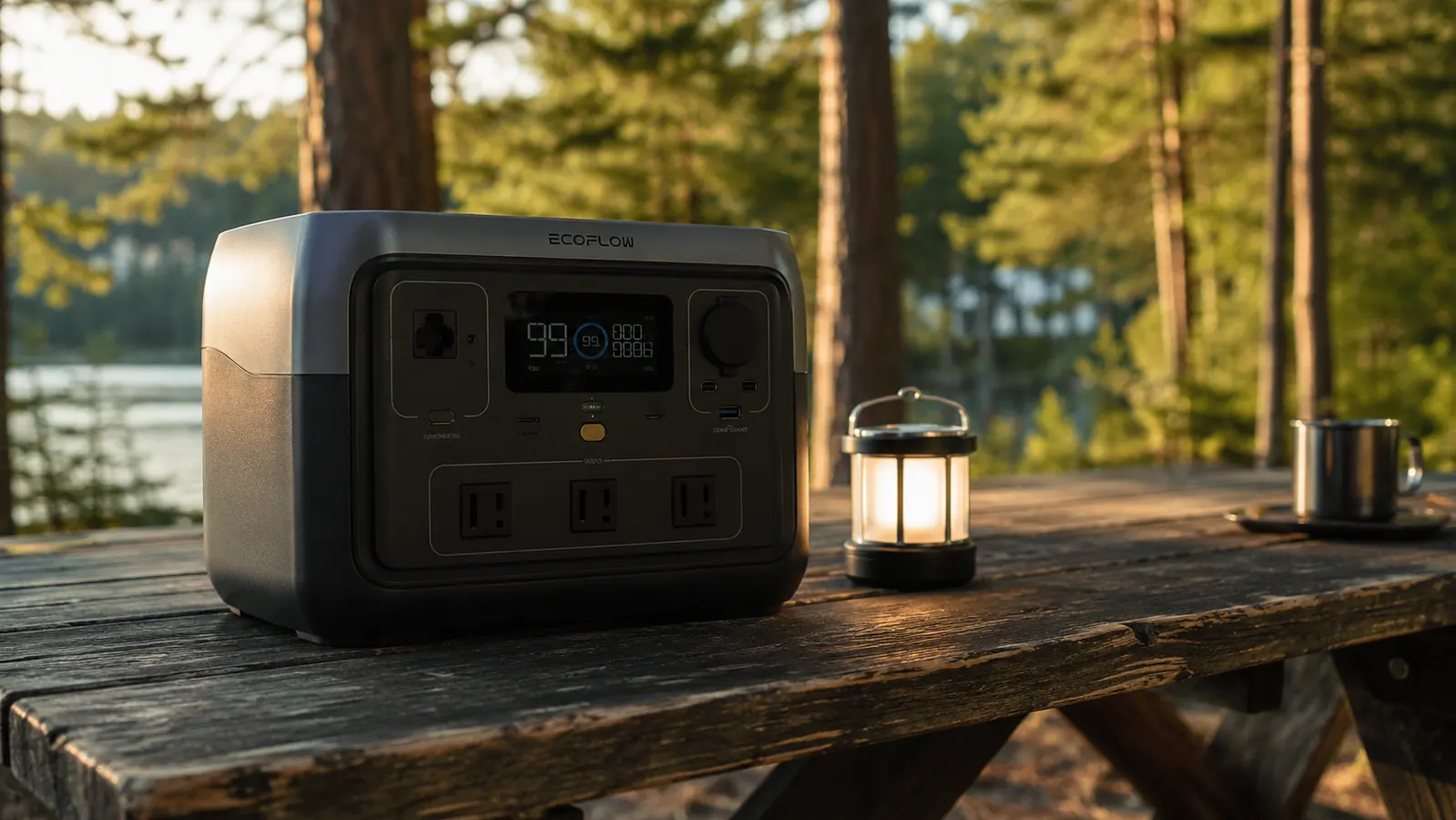
My tentmate Dave uses a CPAP. Has for years. Until two seasons ago, every group trip started with the same negotiation: who parks their truck closest to the site, can we run an extension cord without tripping on it at 2 a.m., and should we just rent a site with hookups and pay triple. The car adapter he tried once drained his truck battery enough that we had a dead vehicle at 7 a.m. on a Saturday in a campground with no cell signal. A generator was out because nobody wanted to listen to it from 10 p.m. to 6 a.m. and the campground would have kicked us out anyway. I started researching portable power stations because Dave's sleep apnea was becoming the group's logistics problem, and the Jackery Explorer 300 kept showing up as the answer that fit in a daypack and didn't require a gas can.
I have now run the Explorer 300 on four separate camping trips over about 18 months, including one four-night stay at a dispersed site in Oregon where it was our only power source. I know what it does well, where the 292Wh ceiling shows up, and when you should spend more. That is what this review covers.
The Quick Verdict
The best portable power station for car campers who need to run a CPAP or keep four people's devices topped off without hauling a generator. The 292Wh capacity is real and the LiFePO4 battery holds its charge cycle after cycle. Not the right pick if you need to run a full-size cooler or an electric kettle for hours.
Amazon Check Today's Price →Before your next trip: check today's price and see if it's still under $200.
The Explorer 300 has been in and out of sale pricing on Amazon. Worth checking current price before you decide whether to step up to a larger unit.
Amazon Check Today's Price on Amazon →How I Have Used It
The bulk of my use has been at car camping sites where I load the Explorer 300 in the back seat, fully charged from a wall outlet the night before departure. On a typical two-night weekend, I am running Dave's CPAP machine (ResMed AirSense 10, about 30-45 watts without the humidifier), charging two phones overnight, running a small 12V Honeywell fan on medium speed for a few hours, and powering a Fenix camp lantern that pulls around 5 watts. That load spread across Friday night and Saturday night leaves roughly 20-30 percent capacity on the display Sunday morning.
On the four-night Oregon trip, we added a third phone and a GoPro battery pack to the rotation. I also tried running a small 12V tire inflator off it one afternoon, which works but draws fast. By night three I was monitoring the display more carefully and cutting the fan back to low. We finished the trip with about 8 percent showing on the LED indicator, which was closer than I would have liked. If you are doing four or more nights with a CPAP and want to run a fan all night, either bring a small solar panel for daytime top-ups or plan to conserve.
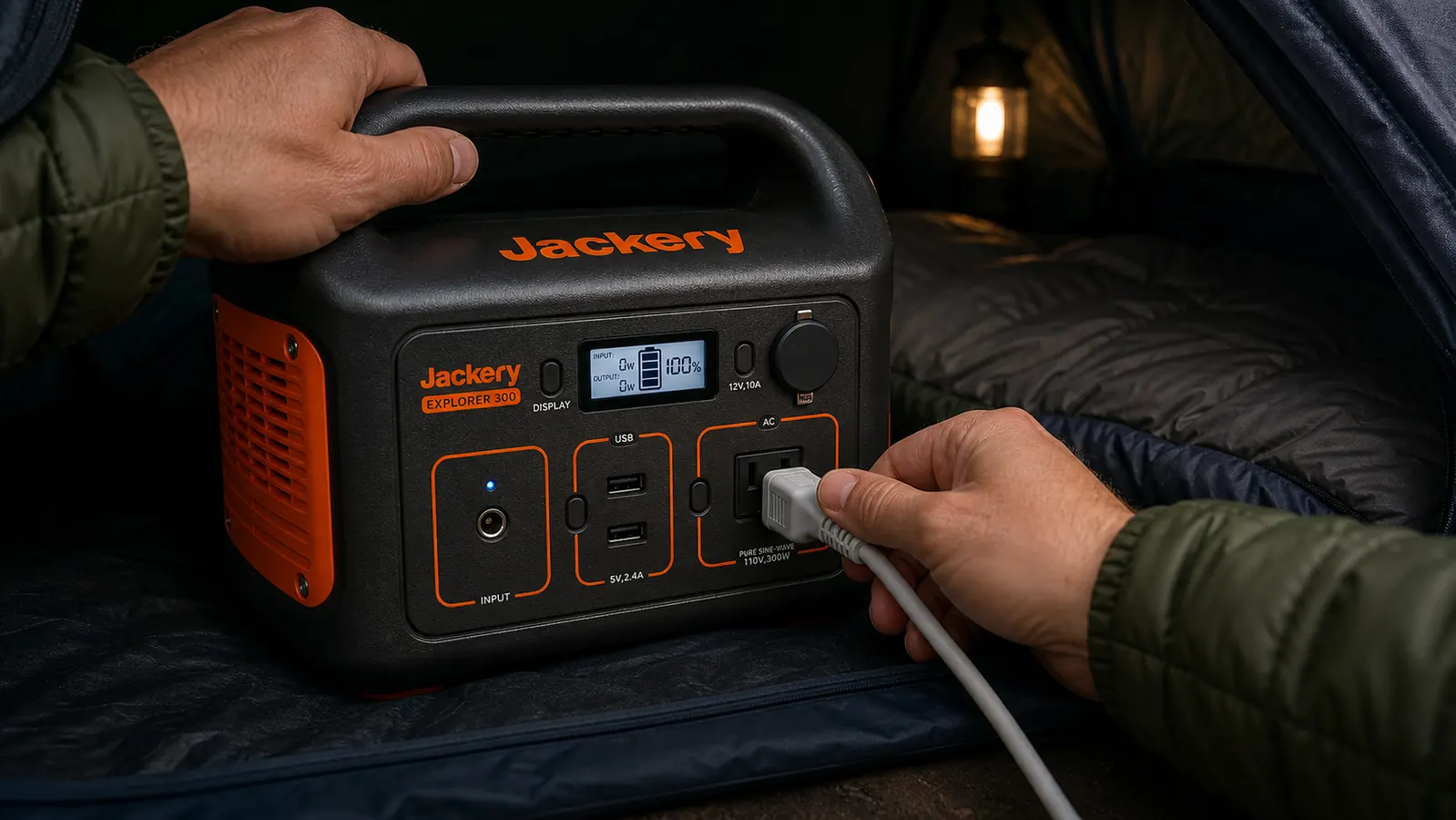
Setup is nothing. You pull it out of the bag, plug things in, press the AC or DC power button depending on what you are connecting, and you are done. The display shows remaining capacity, input wattage if you are charging it, and output wattage. It is not a complicated device, which is most of the point.
The 292Wh Capacity: What That Actually Means at the Campsite
292 watt-hours is the practical number. A modern smartphone battery is roughly 15-18Wh, so in pure phone-charging terms you are looking at 15 to 18 full charges from a dead phone before the Explorer 300 runs out. Nobody is doing 18 phone charges in a weekend, so phones are essentially a free rider on this unit.
The CPAP is where the math matters more. A ResMed or Philips CPAP without the heated humidifier draws roughly 30-45 watts. Eight hours at 37 watts is about 296Wh, which is basically the entire battery for one night. In practice, CPAP machines do not draw max wattage constantly, so real consumption per night lands closer to 150-200Wh depending on the machine and pressure setting. That means two full nights of CPAP use, with power to spare for phones and lights. Dave has confirmed this across several trips.
Where people get surprised is when they try to run higher-draw appliances. A 12V mini-fridge running at 50 watts draws down the Explorer 300 in about six hours. A coffee maker, electric blanket, or hair dryer will hit the 300W AC output limit and either run briefly or not at all. The Explorer 300 is not a kitchen appliance station. It is a device-charging and low-draw-appliance station, which is exactly what car campers who are not plugged into shore power actually need.

LiFePO4 Battery Chemistry: Does It Matter for Camping?
The Explorer 300 uses lithium iron phosphate chemistry, which Jackery brands as LiFePO4. The marketing angle is that LiFePO4 is safer and longer-lived than standard lithium-ion. The safety part is real: LiFePO4 cells are considerably more stable under abuse conditions like high heat, which matters if you are leaving this in a hot car on a drive to the coast in July.
The longevity claim is also real. Jackery rates the Explorer 300 at 2,000 charge cycles to 80 percent capacity. If you charge and discharge it twice a month, which is aggressive camping use, that is over 80 years of cycling. In practical terms, this battery is going to outlast your need for it. I am not worrying about the battery degrading on this unit.
Dave slept through four nights in Oregon without once mentioning the power situation. That is the whole review right there.
One honest note on cold weather: LiFePO4 does lose capacity in temperatures below freezing. I have not taken the Explorer 300 into true winter camping conditions, but Jackery's specs indicate reduced output below 14 degrees Fahrenheit and no charging below 32 degrees. For three-season car camping this is not a concern. For winter basecamp use you would want to store it inside your sleeping quarters overnight.

Build Quality and Portability After 18 Months
The Explorer 300 weighs 6.1 pounds. The handle is solid and balanced, which matters when you are moving it between the car and the picnic table in the dark. The orange plastic housing has taken a few knocks in my truck bed without cracking. The AC outlet cover, the DC port rubber flaps, and the USB-A covers have all held up. I have not had any intermittent port behavior or display issues.
The fan vent on the side runs when the unit is under load. It is audible, roughly the noise level of a laptop fan. In a campsite environment with any ambient sound, you will not notice it. Inside a tent it is present but not disruptive. I have never had the unit run warm enough that the fan behavior felt like a warning.
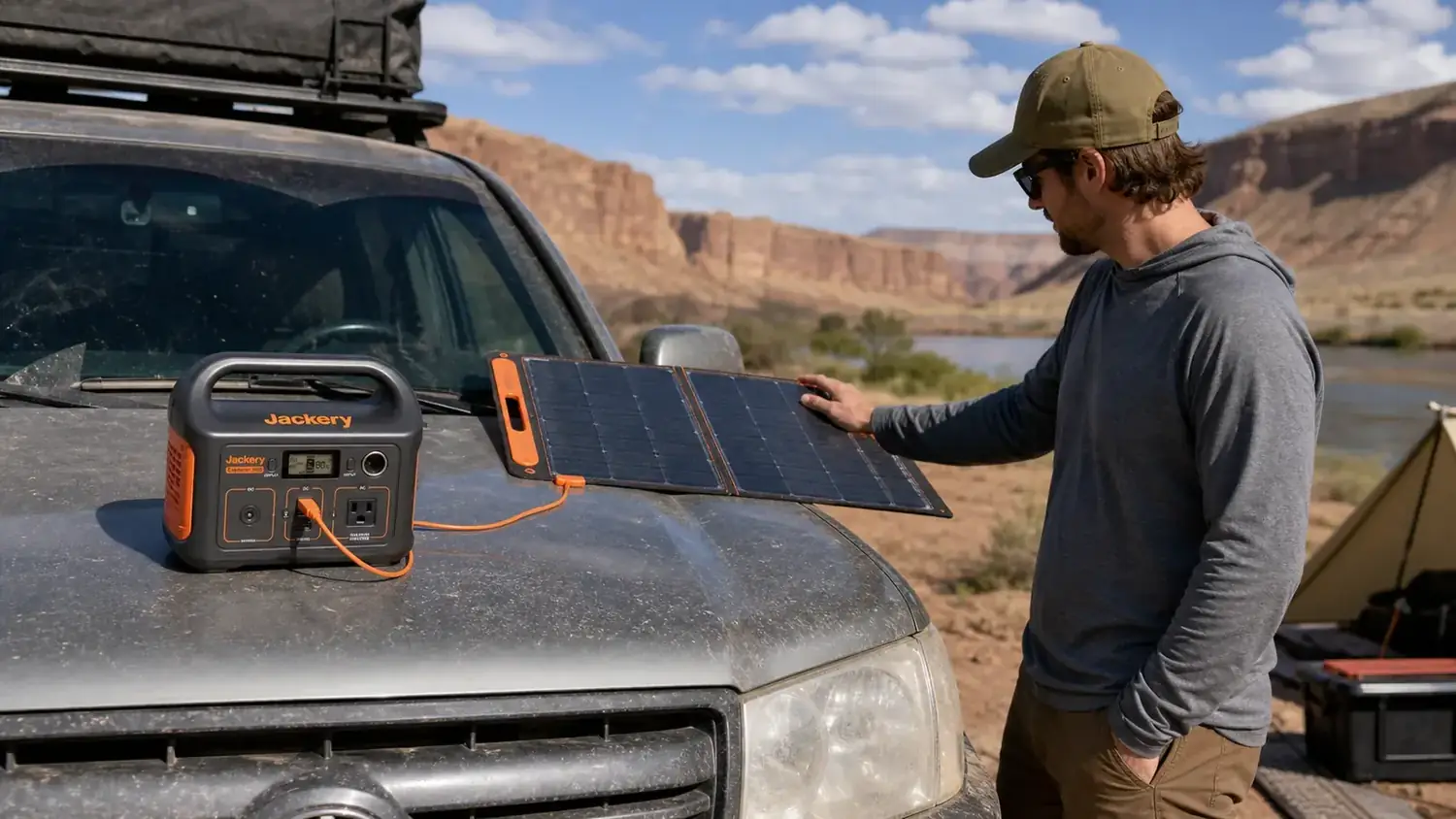
Charging from a wall outlet takes about 6 hours with the included AC adapter. You can also charge from a 12V car outlet while driving, which is useful if you arrive at camp with a partial charge. Solar input via Jackery's optional SolarSaga panels tops it off in roughly 5-6 hours in direct sun with a 100W panel. I have done the car-outlet top-up on the drive home after a trip and arrived back with it at 40 percent, ready to top off overnight for next time.
Alternatives I Considered and Why I Landed Here
The Goal Zero Yeti 200X is the most common comparison. The Yeti 200X has a smaller battery (187Wh vs 292Wh) and costs roughly the same or more depending on the sale. The Jackery wins on pure capacity per dollar for most use cases. The Yeti line has a strong ecosystem and a longer track record, and if you are already deep in the Goal Zero solar panel ecosystem it may make sense to stay there. But if you are starting fresh, the Explorer 300 gives you more headroom for nearly the same price.
Cheaper no-name power stations on Amazon exist at lower price points. I have heard enough failure stories from other trip leaders, including one that caught fire in a tent, that I am not interested in saving forty dollars on a lithium battery that lives in an enclosed space with sleeping people. Jackery has a real warranty and a support line. That matters.
The next step up in the Jackery line is the Explorer 500 (518Wh), which makes sense if you want to run a small cooler or plan longer trips without solar. If your use case is strictly device charging and a CPAP, the 300 is the right size and you will not regret skipping the 500.
What I Liked
- 292Wh is genuinely enough for two nights of CPAP use plus device charging
- LiFePO4 chemistry: stable in heat, rated for 2,000 cycles
- 6.1 lbs and a good carry handle makes it easy to move around camp
- Simple display shows real-time wattage in and out
- Charges from wall, car outlet, or solar panel
- 11,000-plus reviews on Amazon with a 4.6 average is meaningful signal
Where It Falls Short
- 300W AC output ceiling means no hair dryers, electric kettles, or coffee makers
- Four-night trips with high draw require a solar panel or mid-trip conservation
- Charging from wall takes 6 hours, not the fastest in this class
- LiFePO4 capacity drops in freezing temps, limiting winter use
Who This Is For
The Explorer 300 is built for the car camper who wants to stop thinking about power. That means the person in your group who needs a CPAP, the couple who both need phones charged every morning, the family that brings a small fan for each tent, or anyone who has ever killed a car battery trying to run something overnight. If your group has one or two of these situations going on, this unit handles it without drama. It also works well as a base camp power supply for a small group doing day hikes: leave it at camp running the lantern and charging whatever needs charging, then come back to full devices.
Who Should Skip It
If you are running a 12V compressor cooler full-time, a slow cooker, or any appliance that draws more than 150 watts for extended periods, the Explorer 300 will run out before you want it to. Look at the Explorer 500 or the 1000 series. Similarly, if you do extended off-grid trips of five nights or more without reliable sun for solar charging, 292Wh is going to have you rationing. And if you are an occasional camper who does one trip a year with friends who have no medical device requirements and you all have battery packs for your phones, you may not need a portable power station at all. A couple of good Anker power banks will handle device charging for less money.
If a CPAP, a fan, and four phones sounds like your campsite, the Explorer 300 is the answer.
After 18 months and four trips, this is the unit I recommend to anyone in my circle who asks. Check the current price on Amazon and confirm it still makes sense against the Explorer 500 if you are on the fence.
Amazon Check Today's Price on Amazon →