
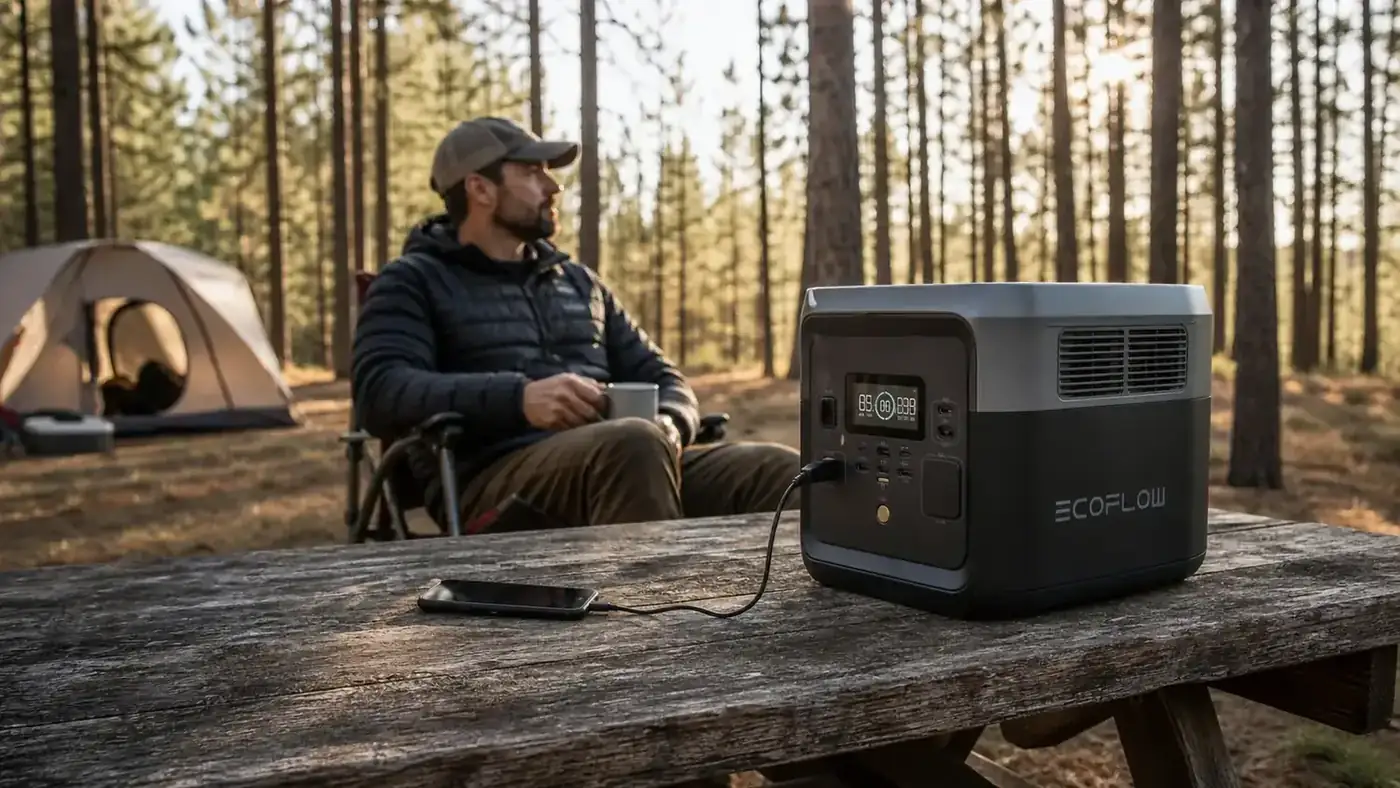
I bought the Jackery Explorer 300 after a trip where I ran out of phone battery on day two and spent the rest of the weekend borrowing a headlamp from a stranger at a neighboring site. That kind of inconvenience is avoidable, and a 292Wh power station seemed like the fix. A year and twelve camping trips later, I have a clear picture of what this unit actually does, what it refuses to do, and which campers should genuinely skip it and size up. This review covers the things most writeups leave out: recharge penalties, pass-through charging behavior, the real capacity ceiling under load, and a few quirks that only show up when you lean on it across a long weekend.
Quick version: the Explorer 300 is a solid, well-made unit for light-duty camping power needs. But the marketing around 292Wh glosses over two real constraints, the recharge time is slow and the capacity disappears faster than you expect once you run anything bigger than a phone. If you go in knowing those two things, you will probably be satisfied. If you buy it expecting a weekend-long power hub for a group, you will be disappointed by Thursday night.
The Quick Verdict
Reliable, compact power station for solo and duo campers who need phone, light, and occasional laptop charging. Shows its limits fast if you add a CPAP or try to run a camp cooler.
Amazon Check Today's Price →Your devices die when you need them most. The Explorer 300 is small enough to bring, big enough to matter.
Check today's price on Amazon and see why 11,000-plus campers have left reviews on this unit.
Amazon Check Today's Price on Amazon →What the Spec Sheet Does Not Tell You About 292Wh
Every power station review leads with watt-hours, and this one will too, but not the way you have seen it before. 292Wh is the rated battery capacity. The usable capacity, after the battery management system reserves a margin and inverter conversion losses are factored in, is closer to 255 to 265Wh in real-world conditions. That is a roughly 10 percent haircut before you plug in a single device.
What does that mean in practice? A smartphone with a 15Wh battery charges about 17 times before you are empty. A laptop drawing 45W gives you roughly five to six hours of run time. A small LED camp lantern at 10W runs for about 25 hours. Those are realistic numbers. What is not realistic: the idea that you can run a CPAP on mid-pressure all night and still have meaningful power left for anything else. A CPAP pulling 35 to 50W runs for roughly five to seven hours on the Explorer 300, which gets most people through one night but leaves the unit at 20 percent or less by morning. Plan accordingly.
The unit also has a 300W continuous AC output limit with a 600W surge. That sounds generous until you realize a standard portable camp cooler like a 40-quart compressor unit pulls 45 to 60W continuously and surges to 150W on startup. The Explorer 300 handles startup fine. The problem is runtime. At 50W draw, you have roughly five hours before the unit is spent. For a weekend trip starting Friday night, that math does not reach Sunday morning on the cooler alone.
The Recharge Time Problem
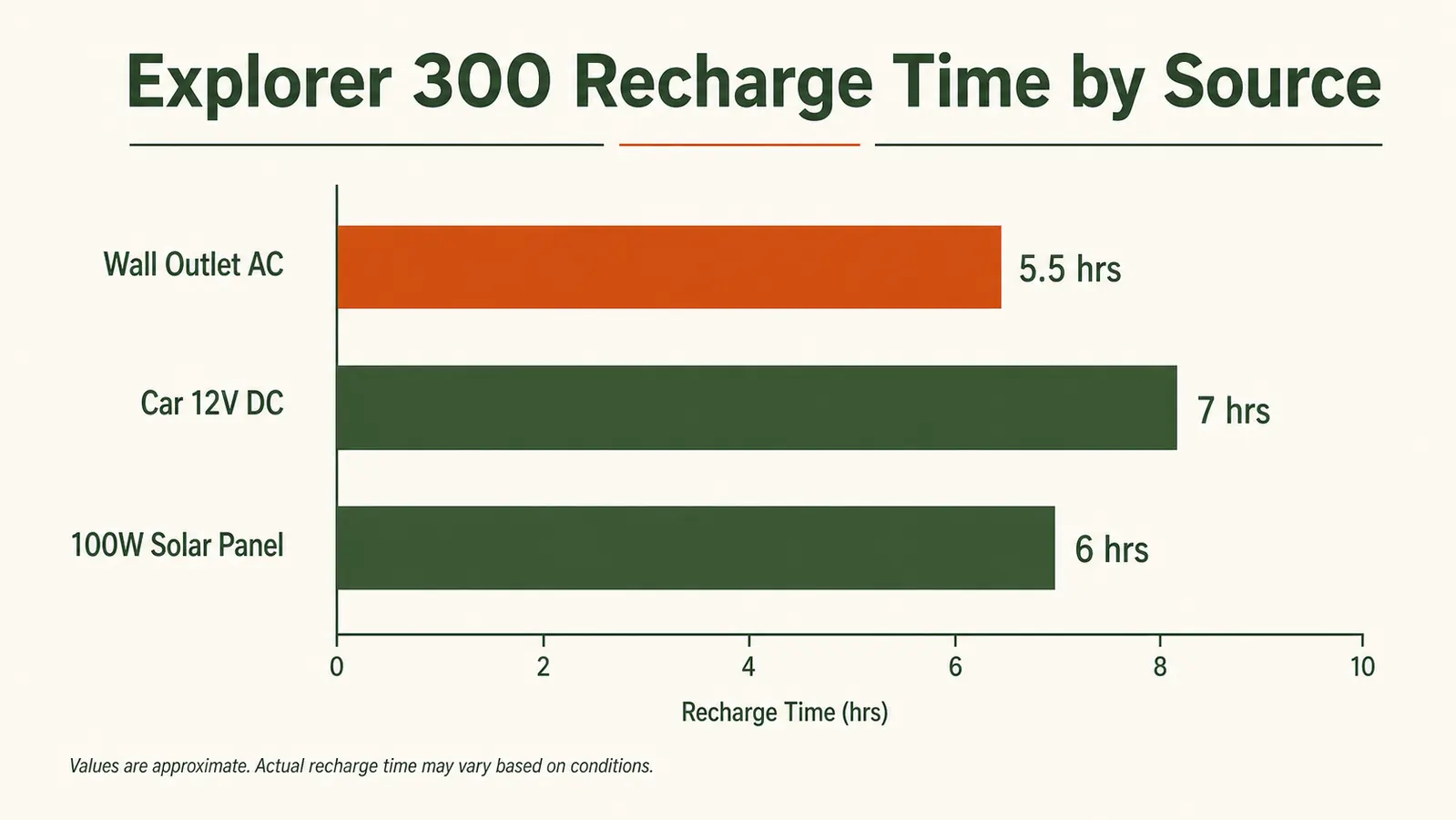
This is the thing nobody mentions loudly enough. The Explorer 300 recharges at up to 85W from a wall outlet. At that rate, a full charge from empty takes right around five and a half hours. That is manageable if you are recharging at home before a trip or have access to a site with electrical hookup. But car camping often means no hookup, and the 12V car charging option tops out at around 12W, which means a full recharge from your vehicle takes fourteen hours. That is not a typo.
Solar input caps at 100W on the Explorer 300, and the unit is compatible with Jackery's SolarSaga panels. A 60W panel in full sun, with no clouds and optimal angle, takes five to nine hours to fully recharge the unit. In the Pacific Northwest in October, where I do most of my shoulder-season camping, that window simply does not exist. On overcast days I was getting 15 to 20W from a 60W panel, which meant topping off the unit by maybe 15 percent over a full afternoon. If you are depending on solar top-up as your recovery strategy on a cloudy trip, build in generous margins or bring a second battery.
The 12V car charging option takes fourteen hours for a full recharge. On a three-day trip, that number matters more than the capacity spec.
Pass-Through Charging: The Quirk Most Reviews Skip
Pass-through charging means using the power station while it is simultaneously recharging. The Explorer 300 supports this, but with a caveat Jackery downplays in the product description: running devices while charging the unit increases heat buildup and the battery management system may throttle incoming charge rate to protect the cells. In hot ambient conditions, like a sun-baked campsite in July, I found the wall charge rate drop from the rated 85W to somewhere in the 55 to 65W range when I was also running a laptop off the AC port. That extends recharge time meaningfully.
More importantly, Jackery advises in their documentation against using pass-through charging as a daily operating mode for the battery's long-term health. Occasional pass-through is fine. Using it as a strategy every trip will degrade cycle count faster than normal charge-discharge cycles. This is true of almost every lithium power station at this price point. It is not a deal-breaker, but it is worth knowing if you are planning to run devices off the unit while it recharges from your car outlet on the drive to the campsite.
The LiFePO4 Battery Chemistry: Does It Actually Matter?
The Explorer 300 uses lithium iron phosphate cells, commonly abbreviated LiFePO4. Jackery markets this as a safety and longevity advantage over older NMC lithium-ion chemistry, and that claim is accurate. LiFePO4 cells are thermally more stable, meaning they are less prone to thermal runaway in high-heat conditions, and they have a higher rated cycle count. Jackery rates the Explorer 300 at 800 charge cycles to 80 percent capacity, versus the 500 cycles typical of NMC units at similar price points.
In practical terms for a weekend camper: if you take twenty camping trips per year and do a full charge cycle each trip, you are looking at forty years of battery life at rated specs. The LiFePO4 chemistry matters much more for full-time van lifers doing daily cycles than for someone using this unit twenty to thirty times a year. For most car campers, the battery chemistry is a genuine quality signal, but it is not the primary reason to choose or skip this unit. Weight and capacity are more meaningful decision factors for the average buyer.

Weight and Portability: The Honest Trade
The Explorer 300 weighs 7.1 pounds. That puts it in a middle tier: lighter than larger-capacity stations but noticeably heavier than a small battery bank. For car camping where you carry gear from trunk to campsite, 7.1 pounds is easy. For anyone considering this for a base camp where you hike in gear over a mile or more, it is a real weight to account for. I have carried it two miles in on three occasions and it is manageable but it will earn its spot in your pack decision.
The dimensions are 9.1 by 5.2 by 5.4 inches. It fits in a medium backpack side pocket on its edge or in the main compartment without dominating space. The rubber carrying handle is sturdy and does not flex under load, which sounds minor until you are carrying it one-handed while managing a tent bag and a cooler with the other arm. Build quality on the handle and housing feels solid. I dropped this unit off a picnic table onto compacted dirt from about two feet in year one and the housing scuffed but nothing cracked or failed electrically.
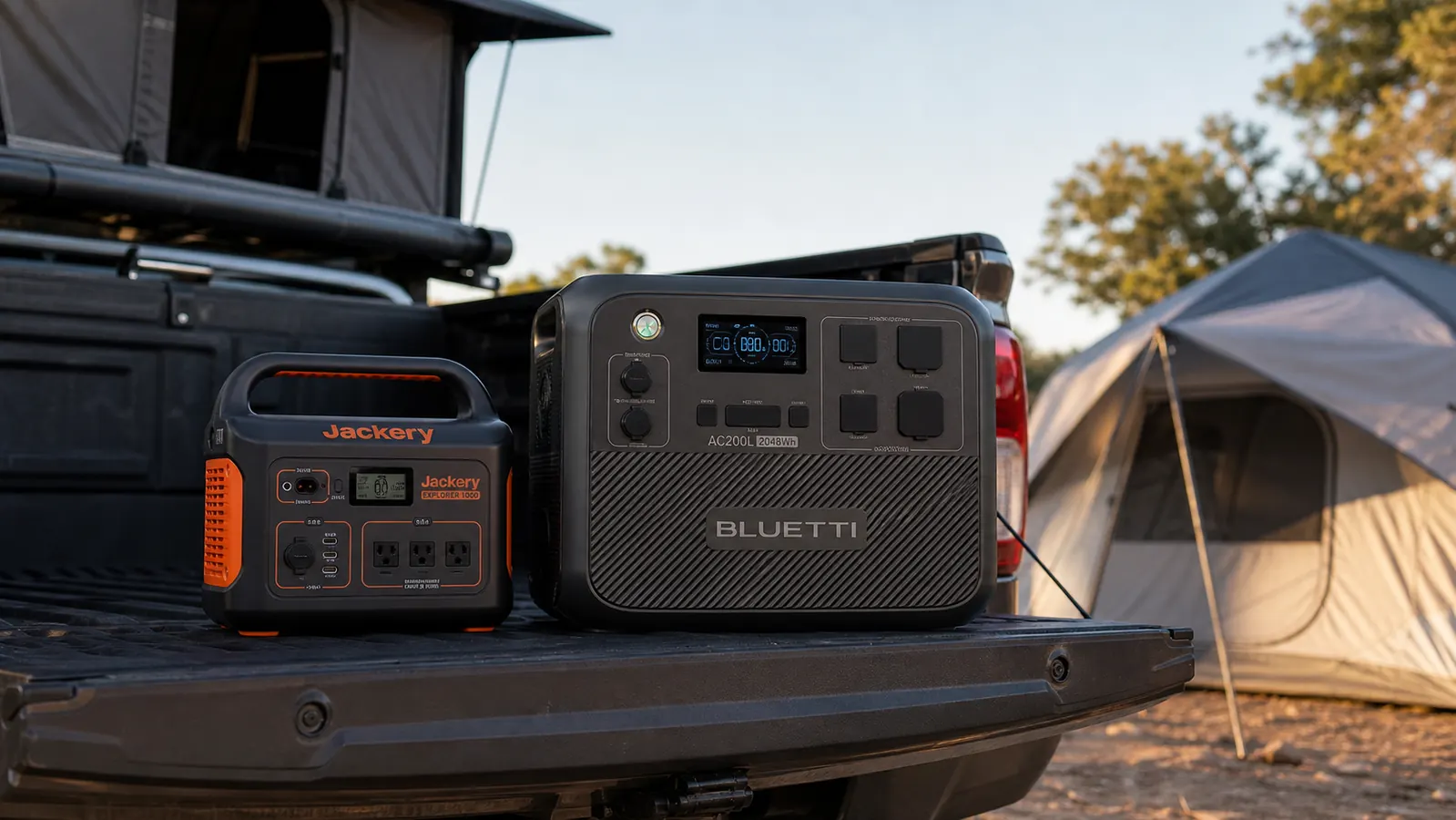
Compared to the Goal Zero Yeti 200X, which has a smaller 187Wh capacity and uses NMC chemistry, the Jackery is about 1.5 pounds heavier but offers 56 percent more usable capacity. Compared to the Jackery Explorer 500, which has 518Wh, you get roughly half the capacity for about half the weight. The Explorer 300 sits at a genuine middle point in the lineup that works well for solo campers and duos. If you are regularly camping with three or four people and everyone has devices, the 500 is a more honest fit. See the full breakdown in our Jackery Explorer 300 vs Goal Zero Yeti comparison.
How I Actually Manage the Load After a Year
After twelve trips I have settled into a routine that gets the most out of the Explorer 300 without running into capacity anxiety. I arrive at the site with the unit fully charged. I run USB-C charging for phones and my headlamp through Friday night and Saturday morning without touching the AC port. Saturday afternoon, when the cooler is at temperature and does not need to cycle as frequently, I switch the cooler to the Explorer 300 for a few hours if I need to run the AC port for something else. By Saturday evening the unit is usually around 40 to 50 percent, which is enough for overnight camp light duty and phone charging through Sunday morning.
What I do not do: run the AC port and the USB ports simultaneously at high draw for extended periods, and I never plan around the car charger topping me off on a trip. Those two habits took the unit from a source of mild frustration on my first three trips to a reliable piece of kit I stop thinking about. The Explorer 300 rewards a bit of load discipline. If you treat it like a wall outlet, it will let you down by Saturday afternoon. If you treat it like a finite resource and prioritize accordingly, it handles a weekend without drama.
What I Liked
- LiFePO4 chemistry rated to 800 cycles, meaningfully better longevity than NMC competitors at this price
- Compact at 7.1 lbs and fits easily into a car camping kit without dedicated gear space
- Three AC outlets plus two USB-A and one USB-C port covers most device combinations
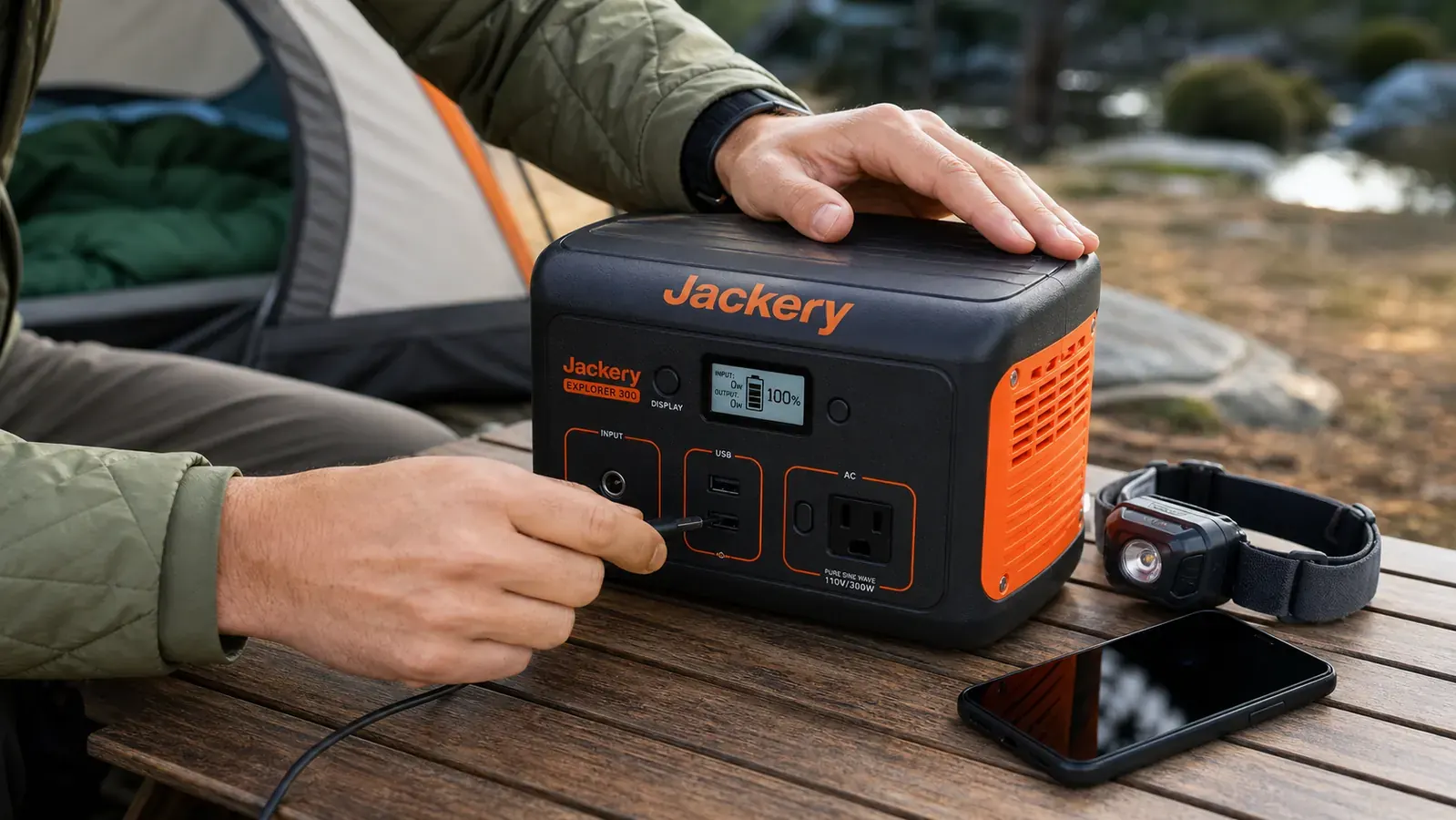
- Straightforward LCD display shows remaining capacity, input wattage, and output wattage simultaneously
- Handles laptop and phone charging quietly with no fan noise at low load levels
- Build quality is genuine: solid housing, sturdy handle, no flex or creaking after a year of use
Where It Falls Short
- 292Wh usable capacity drops to roughly 255-265Wh in real conditions after BMS and inverter losses
- Wall recharge time of 5.5 hours is slow compared to newer fast-charge competitors at similar price
- 12V car charging at 12W max means 14-hour recharge time, which makes vehicle top-up impractical on short trips
- Pass-through charging throttles charge rate under load and Jackery advises against using it as a regular mode
- Not enough capacity for a camp cooler plus a CPAP over a full three-day weekend without a recharge opportunity
- Solar recovery on overcast days can be as low as 15-20W, making solar top-up unreliable in cloudy climates
Who This Is For
Solo campers and couples who need reliable phone charging, a headlamp top-up, and occasional laptop use will find the Explorer 300 genuinely useful. If your camping kit does not include a CPAP machine, a compressor cooler, or high-draw power tools, the capacity is usually enough for two to three nights before you need a recharge. The unit is also a reasonable fit for festival camping and van weekend trips where you have a wall outlet at home before you leave and again when you return. The build quality, LiFePO4 longevity, and port selection are all legitimate strengths at the current price point.
It also holds up well for emergency preparedness use: keeping it fully charged at home costs almost nothing and it will power essentials through a short power outage without complaint. That dual use case, camping plus home backup, is real and worth factoring into the value equation. Check our 10 reasons a power station belongs on every camping trip for more context on how a unit like this fits a broader camp kit.
Who Should Skip It
If you run a CPAP every night and also want to charge phones, run a camp light, and keep a small cooler going, the Explorer 300 will be a source of anxiety by day two. Size up to the Explorer 500 or a 500Wh competitor and save yourself the rationing math. Similarly, if you camp in groups of three or more where everyone has phones, tablets, and a shared camp light, the 292Wh ceiling will feel tight by the second morning. The unit is not marketed poorly, it is just priced and sized for a specific use case that some buyers miss.
Backpackers who are considering this as a multi-day carry should think hard about the weight-to-capacity ratio. At 7.1 pounds for 292Wh, you can carry lighter options for phone and headlamp charging needs. A 40,000mAh battery bank at under two pounds handles most backpacker power needs for a fraction of the weight. The Explorer 300 earns its weight at a car camping site. It does not earn it in a pack over a mountain.
Buyers who expect fast solar recovery in variable weather should also recalibrate expectations before purchasing. The 100W solar input is rated under ideal conditions. Cloudy days in real camping environments often deliver 15 to 30 percent of rated input. If your camping style involves multi-day trips in regions with reliable sun and you plan to pair this with a 100W panel, it can work. If you are camping in the PNW from September through May, build your power strategy around a full pre-trip charge from the wall and treat solar as a bonus, not a recovery plan.
You know the limitations now. If the Explorer 300 still fits your kit, today's price on Amazon is worth checking.
Over 11,000 reviews, real-world tested, and one of the better-built units at this capacity. See the current price and bundle options.
Amazon Check Today's Price on Amazon →