
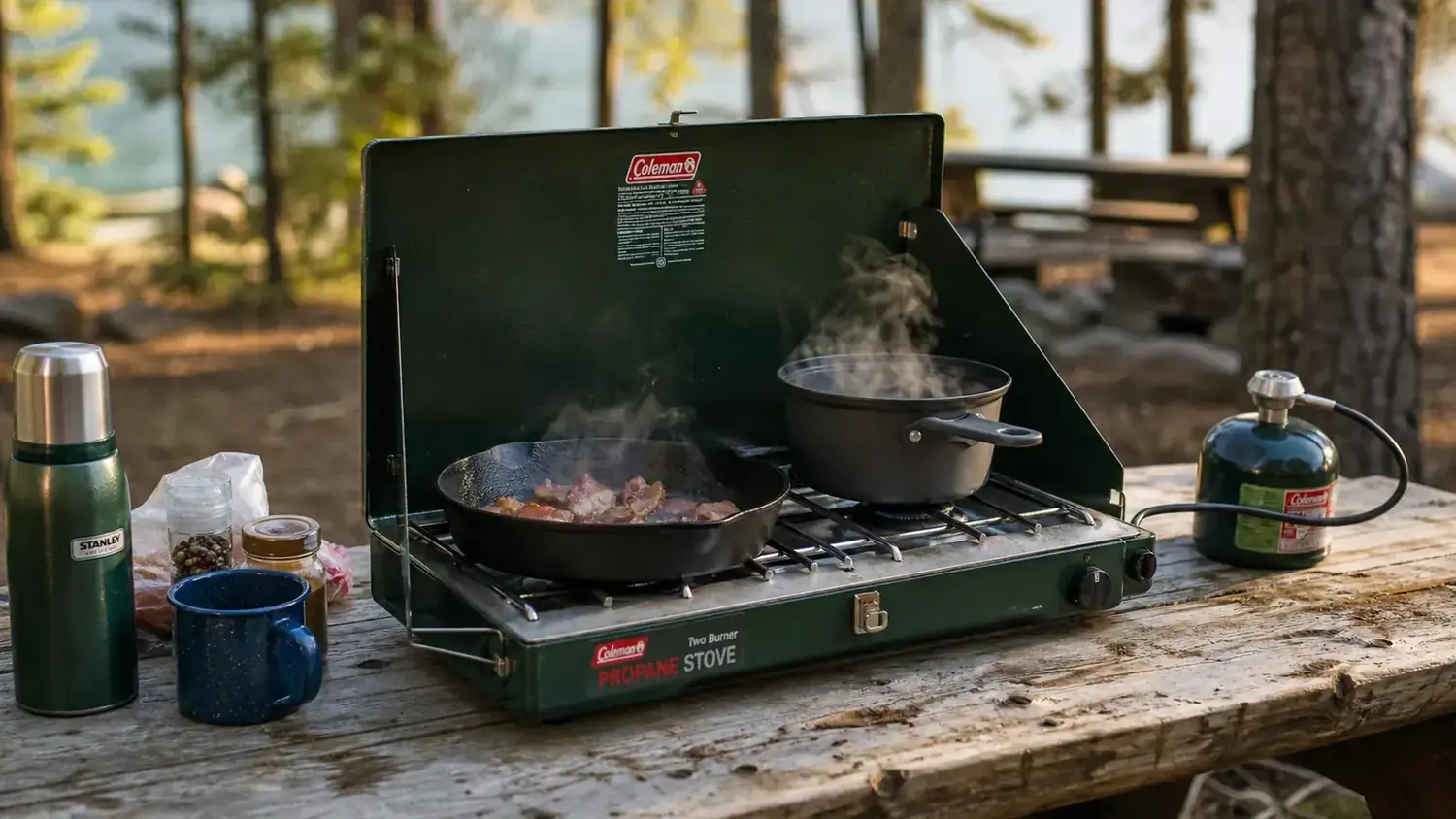
Camp cooking has a reputation problem. Ask most people what they eat on a camping trip and you get the same short list: hot dogs on a stick, instant ramen, cold sandwiches, maybe a can of soup warmed over a campfire. That is not because those are good options. It is because a lot of people have never cooked with a proper camp stove and have no idea what is actually possible. A two-burner propane stove changes the math completely. I run this guide using the Coleman Triton 2-Burner as the reference stove, because its two independently adjustable burners handle everything described here without modification. You can run eggs and bacon at the same time, simmer pasta while you saute vegetables on the other burner, and have a real dinner on the table in under 30 minutes. The setup is not complicated, but there is a sequence that makes it work. I have cooked hundreds of camp meals over the years and this is the approach that holds up.
Fire cooking is fine for atmosphere and for the occasional foil packet. What fire cooking is not good for is heat control, timing two dishes at once, or cooking when it is raining and the wood is wet. A campfire is not a stove. A camp stove is a stove. The difference shows up the moment you try to do anything more involved than heating water.
If your camp dinners still start with tearing open a foil pouch, this stove is what is missing.
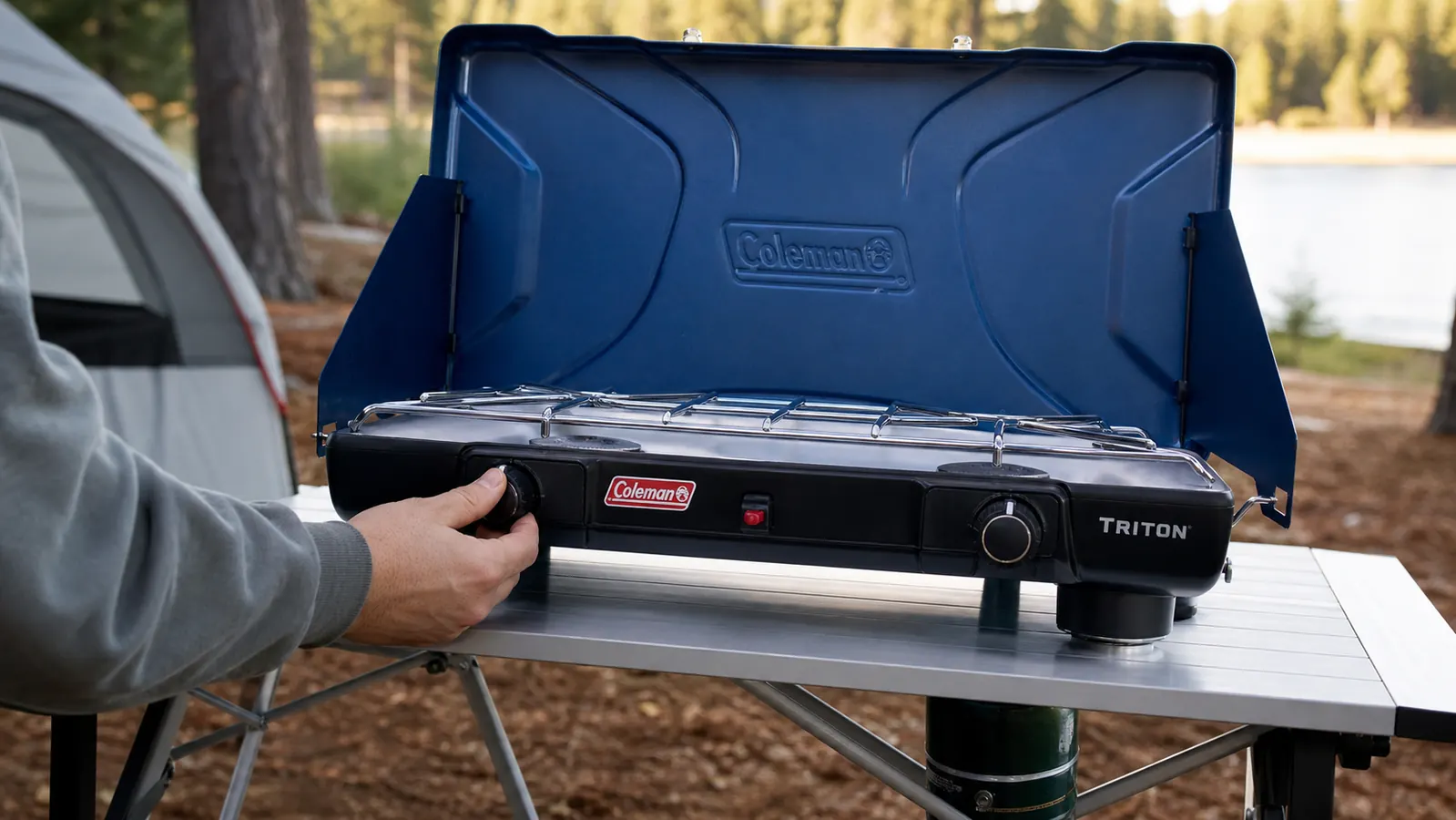
The Coleman Triton 2-Burner runs two independently adjustable burners with enough BTU output to cook a real meal while your water comes to a boil on the other side. It is what I reach for on every trip where dinner matters.
Amazon Check Today's Price on Amazon →Step 1: Pick Three Meals, Not Five
The biggest mistake people make with camp cooking is over-planning. They pack ingredients for five elaborate dinners and end up eating granola bars by night three because they are tired and the prep work looked like too much in the dark. Plan three real meals for a three-night trip. That means one meal per night, and the other two nights are simpler on purpose: one night is a fire-cooked foil packet or hot dogs, and one night is eating in town or hitting a trailhead diner. Three ambitious meals over four days is exactly the right amount.
For those three meals, stick to recipes you already know how to cook at home. The campsite is not the place to try something new. If you make a good stir-fry at home, you can make it at the campsite. If pasta with sausage and vegetables is easy for you in a kitchen, it will be easy on a two-burner stove. The only variable that changes is heat distribution and wind. Everything else translates.
Write your ingredient list per meal, not per day. That forces you to think through each recipe specifically and prevents the common problem of packing three kinds of oil and forgetting salt. One bottle of olive oil handles everything. One container of your go-to spice mix covers most of what you will cook. Keep the pantry ingredients lean.
Step 2: Do the Fuel Math Before You Leave Home
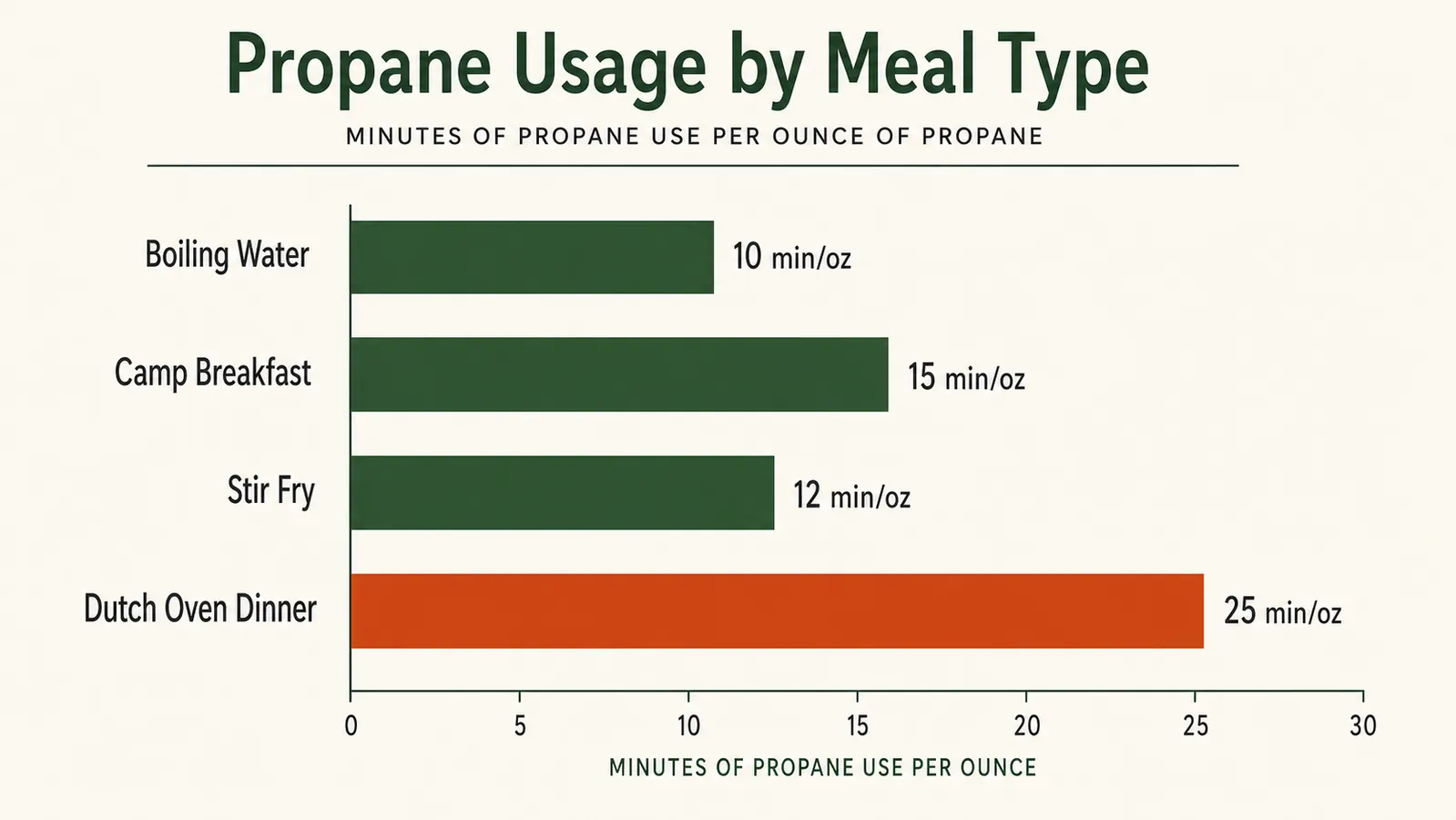
Propane fuel is the piece most people get wrong, and running out mid-trip is one of the more frustrating avoidable problems in camping. A standard 1-lb propane canister holds about 16 oz of fuel. Boiling a pot of water uses roughly 0.5 oz. Cooking a full breakfast with eggs and bacon on both burners for 15 minutes uses about 1.5 to 2 oz. A 20-minute dinner on both burners uses 2 to 3 oz. Across a three-day trip with three real cooked meals and morning coffee or oatmeal each day, you are looking at 10 to 14 oz of fuel total.
That means one 1-lb canister is enough for a weekend trip if you are cooking simply. Bring two to be comfortable, especially if nights are cold. Cold temperatures reduce propane output, so a canister that would last a weekend in July might run short in October. I carry two canisters on any trip longer than two nights, regardless of season. At a few dollars each, it is cheap insurance.
Step 3: Set Up Your Camp Kitchen Before You Cook Anything
Cooking goes wrong at the campsite when you try to cook while also setting up. Get your kitchen area established when you first arrive at camp, well before dinner. That means: stove on a flat, stable surface, ideally a picnic table or a folding camp table, not the ground. Propane canister connected and valve checked. Cookware unpacked and within reach. Cooking utensils, oil, and spices in one bag that lives next to the stove. Paper towels accessible. Trash bag hung or in a bear box if your site requires it.
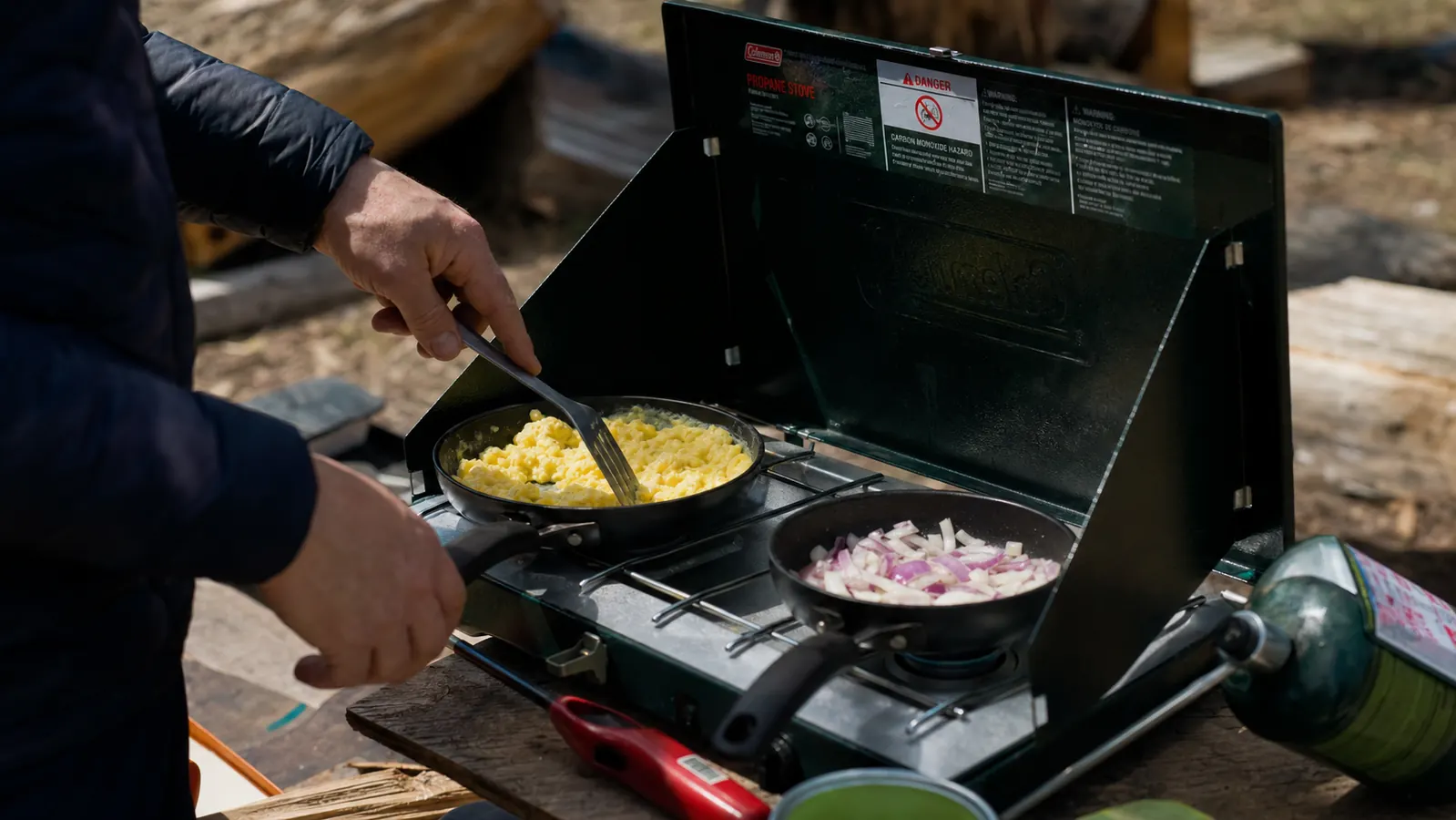
The windscreen panel on a two-burner stove like the Coleman Triton matters more than people expect. It is not decorative. Wind will pull heat off your burner fast enough to double your cook time on an exposed site. If your stove has a fold-up windscreen, use it. Position the stove so the wind is hitting the side or back of the unit, not blowing directly across the burners. On an exposed site with a real headwind, rotate your setup until you find a position where the flame holds without flickering. This alone is worth five minutes of adjustment.
Keep your food prep station separate from your stove. A cutting board on one side of the table, stove on the other. You want room to move without reaching over an open flame.
Step 4: Cook in the Right Order
Two-burner cooking at the campsite is a timing exercise, same as cooking at home on a two-burner range. The key is knowing what takes longest and starting that first. Pasta water is the classic example: put water on to boil as your first move, before you do any other prep. It takes longer than you think, especially at elevation. By the time you have cut vegetables and sauteed protein on the second burner, the water is ready. Everything finishes at the same time.
For a camp breakfast, the order is: start bacon or sausage on medium heat first, because it takes 8 to 10 minutes and benefits from slow rendering. While the meat is going, crack eggs into a bowl and season them. When the meat is nearly done, push it to one side of the pan or move it to a plate to rest. Eggs go in the residual fat. Done in two minutes. Everything hits the plate at the same temperature and nothing has been sitting cold while you wait for something else to finish.
The windscreen panel on a camp stove is not decorative. On an exposed site, wind will pull heat off your burner fast enough to double your cook time.
For stir-fry, which is one of the best camp meals because it is fast and uses one pan: get your oil hot before you add anything. At high altitude, this takes longer than at sea level. Add protein first, cook through, push to the sides. Add vegetables in order from hardest to softest. Sauce goes in at the end with a lid for 60 seconds to finish. Total time from first ingredient to plate is 12 to 15 minutes on a high-output burner.
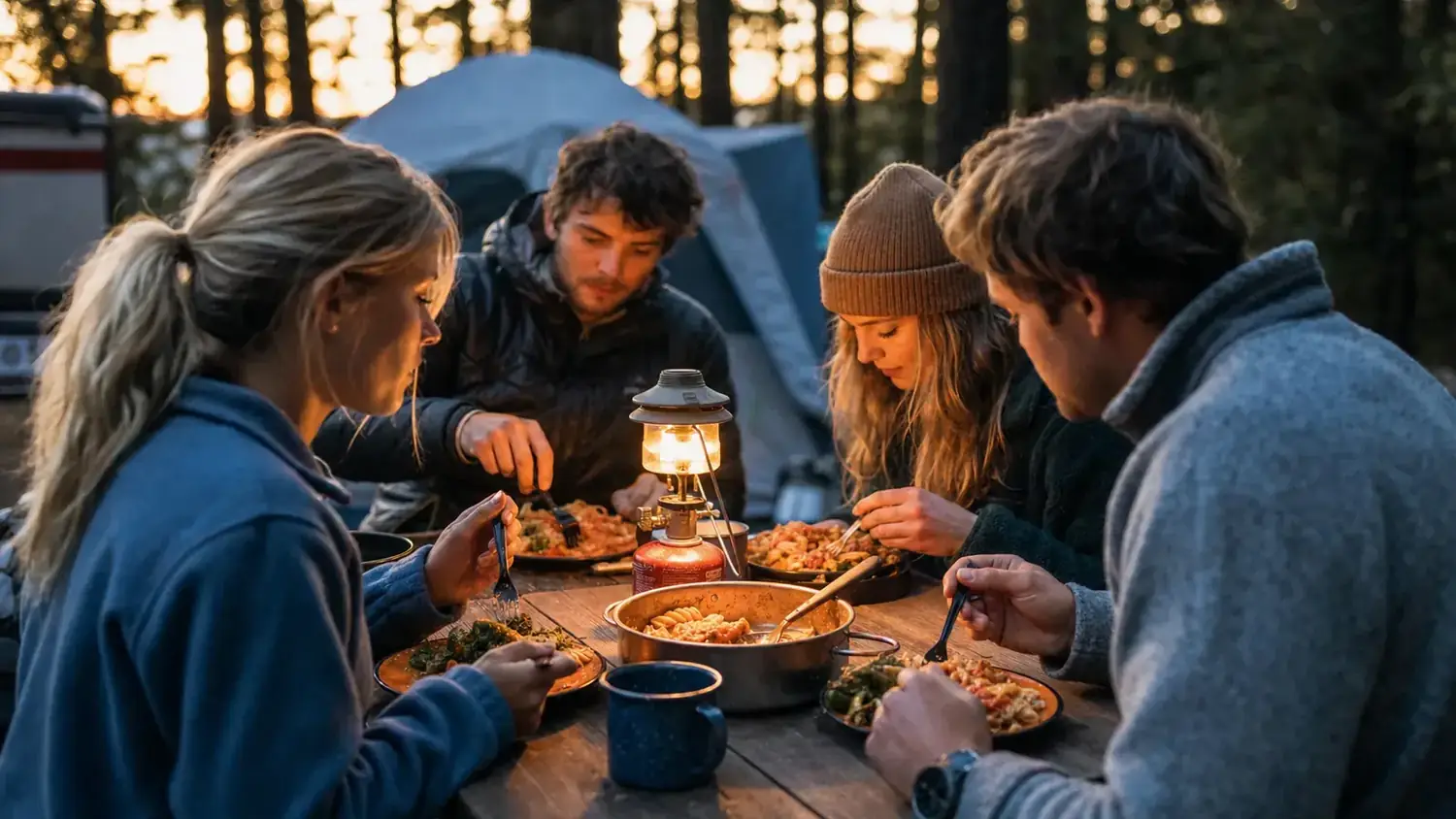
Step 5: Clean Up the Right Way and You Will Not Hate Yourself in the Morning
Campsite dishwashing is the part that makes or breaks your next cooking session. If you leave pans greasy overnight, you wake up to hard, cold grease and a scrubbing job that kills your morning. The field method that works: while the pan is still warm from cooking, wipe it with a paper towel to pull out the majority of grease and food bits. Then add a small amount of water, heat it briefly on the stove to loosen anything stuck, dump the water in a cathole or grey water sump at least 200 feet from your campsite and water sources, then wipe again. For a final rinse, a small amount of biodegradable soap and water and a camp sponge finishes the job.
Cast iron at the campsite does not need soap. Wipe clean, heat until dry, add a thin coat of oil, let it cool. That is it. Non-stick camp pans can take a mild dish soap without issue. Keep your wash water grey, not black. Black dishwater means food particles that attract wildlife.
Store your clean stove with the burner caps seated properly and the propane canister disconnected if you will not be cooking for more than a few hours. At night, disconnect the canister. It takes five seconds and removes any risk of a slow leak.
What Else Helps
A lightweight 10-inch skillet and a 2-quart saucepot handle about 80 percent of camp cooking situations. A lid that fits the skillet is useful and often overlooked. A long-handled silicone spatula and a pair of tongs round out what you actually need. Everything else is optional weight.
A small headlamp on a table, not on your head, acts as a worklight when you are cooking after dark. Cooking with a headlamp strapped to your forehead means your shadow falls on whatever you are looking at. Set the headlamp on the table angled at the cooking surface and you will see what you are doing. This is a small thing that makes late dinners significantly less frustrating.
Pre-measure your spices and dry ingredients into small labeled bags at home. It adds maybe 15 minutes of prep before the trip and saves a lot of fumbling at the campsite when you are tired and it is getting dark. Cooking in the field is easier the more you front-load the prep work before you leave.
If you are car camping, a small folding camp table dedicated to the stove and kitchen is worth the cargo space. It gets the cooking surface off the ground, off the food-prep surface, and at a height that is actually ergonomic to cook at. Cooking crouched over a picnic bench because your stove is in the wrong position is the kind of small discomfort that accumulates over a long cooking session.
The Stove That Makes This Work
All of the above works with a decent two-burner propane stove. The Coleman Triton is what I have used for the last several seasons. Two independently adjustable burners, a fold-up windscreen, and it packs flat for transport. The burners run hot enough to boil water in a reasonable amount of time and low enough to hold a simmer without scorching. The grates are stable under a cast-iron skillet. At the current price point, it is competitive with everything else in its class. You can read a more complete breakdown in my full review over at Coleman Triton 2-Burner Propane Stove Review, and if you are still on the fence about whether a two-burner stove is worth the investment at all, the 10 reasons to upgrade from fire cooking is a good starting point.
What a camp stove cannot do is make you a better cook. But it can give you the tools to cook the same way you do at home, just outside. That is all you actually need.
You have the plan. Here is the stove that runs it.
The Coleman Triton 2-Burner gives you independent heat control on both burners, a wind panel that holds flame in exposed sites, and a pack-flat design that fits in the back of any car. It has 4.7 stars across more than 3,500 reviews for a reason.
Amazon Check Today's Price on Amazon →