
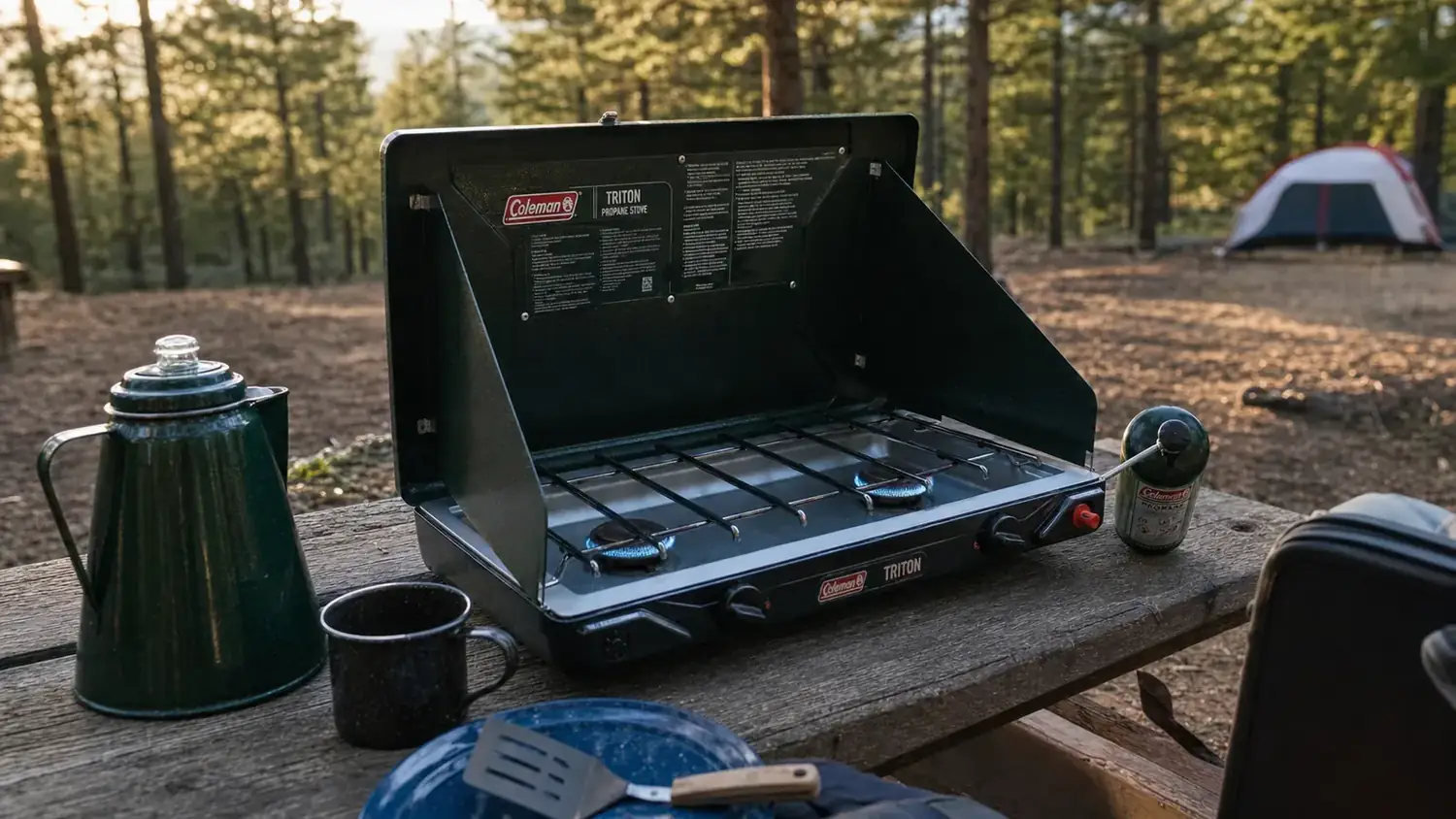
Most car campers fall into one of two traps. Either they are crouched over an open fire trying to flip pancakes on a grate that shifts every 30 seconds, or they went and bought a single-burner backpacking stove that was never designed to feed more than one person in the first place. Neither of those is a real camp kitchen. The Coleman Triton 2-Burner Propane Stove is what I started using about three years ago after getting tired of both options, and at this point it has seen more campfire-free breakfasts than I can count.
I am not here to tell you it is perfect. It has real tradeoffs and there are people who should spend their money on something else. But for the weekend car camper cooking for two to four people, it covers the bases better than anything else I have tested at this price.
The Quick Verdict
A dependable, properly sized car camping stove with good heat control and a wind panel that actually works. Not ultralight, not heavy-duty, and not trying to be either.
Amazon Check Today's Price →Still cooking over fire or on a single-burner? The Triton fixes that with two adjustable burners and a wind panel that earns its keep.
The Coleman Triton is one of the most straightforward buys in car camping. Two independent burners, folds flat, and runs on standard 1-lb propane canisters you can get anywhere.
Amazon Check Today's Price on Amazon →How I've Used It
My first season with the Triton covered four car camping trips, including two rainy weekends in the Olympic Peninsula where wind and moisture were a constant. I cooked on it in temperatures from about 38 degrees to 85 degrees, at elevations from sea level to just under 7,000 feet, and in crosswinds that would have killed a smaller stove's flame before I could boil water.
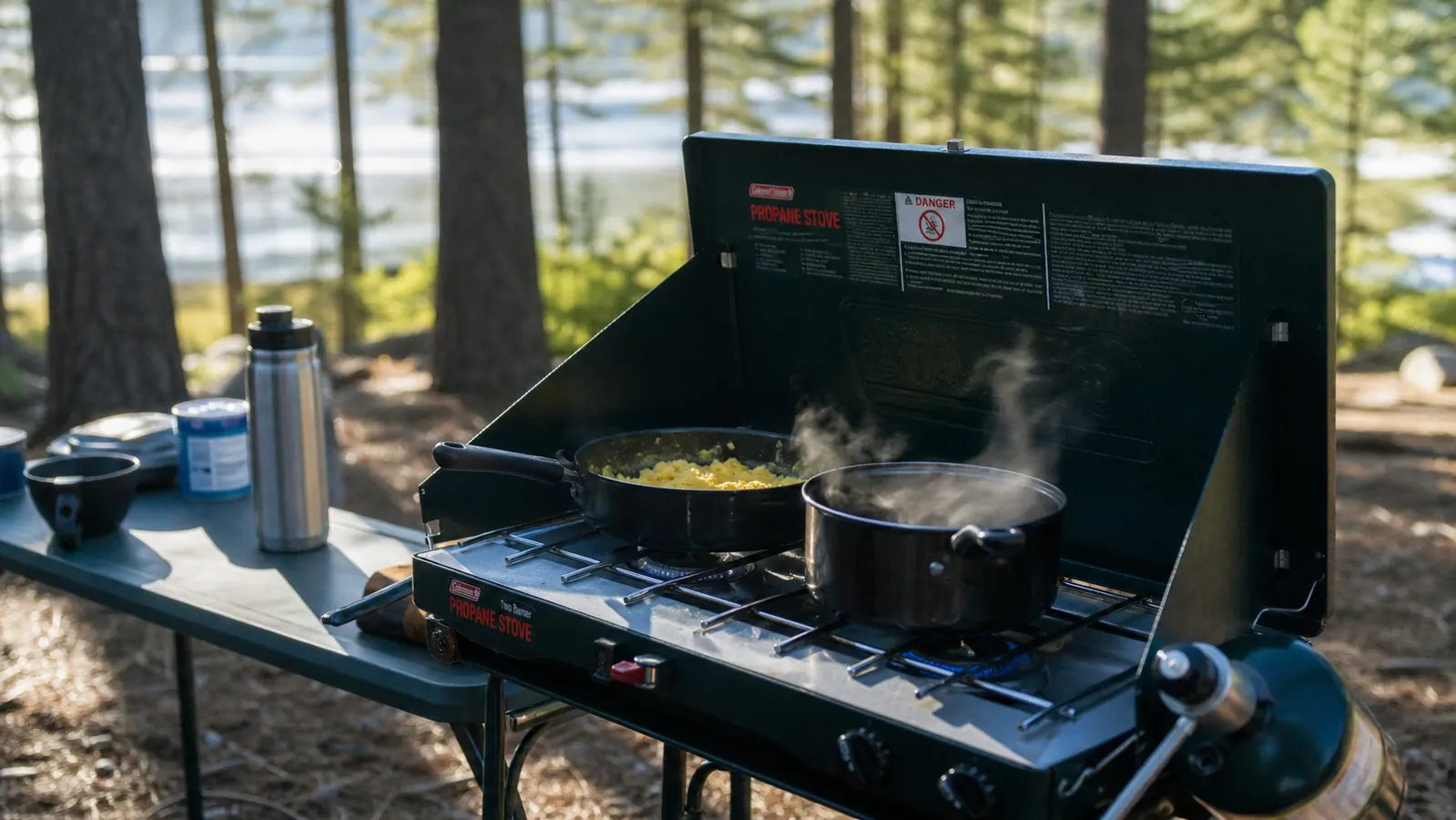
A typical use for me is a full group breakfast: bacon or sausage on the left burner over medium heat while eggs or pancakes go on the right. Then I kill the left burner and keep the right one low to hold heat while I plate. Having two independently adjustable burners sounds obvious until you have spent seasons without them. It changes how you cook outside.
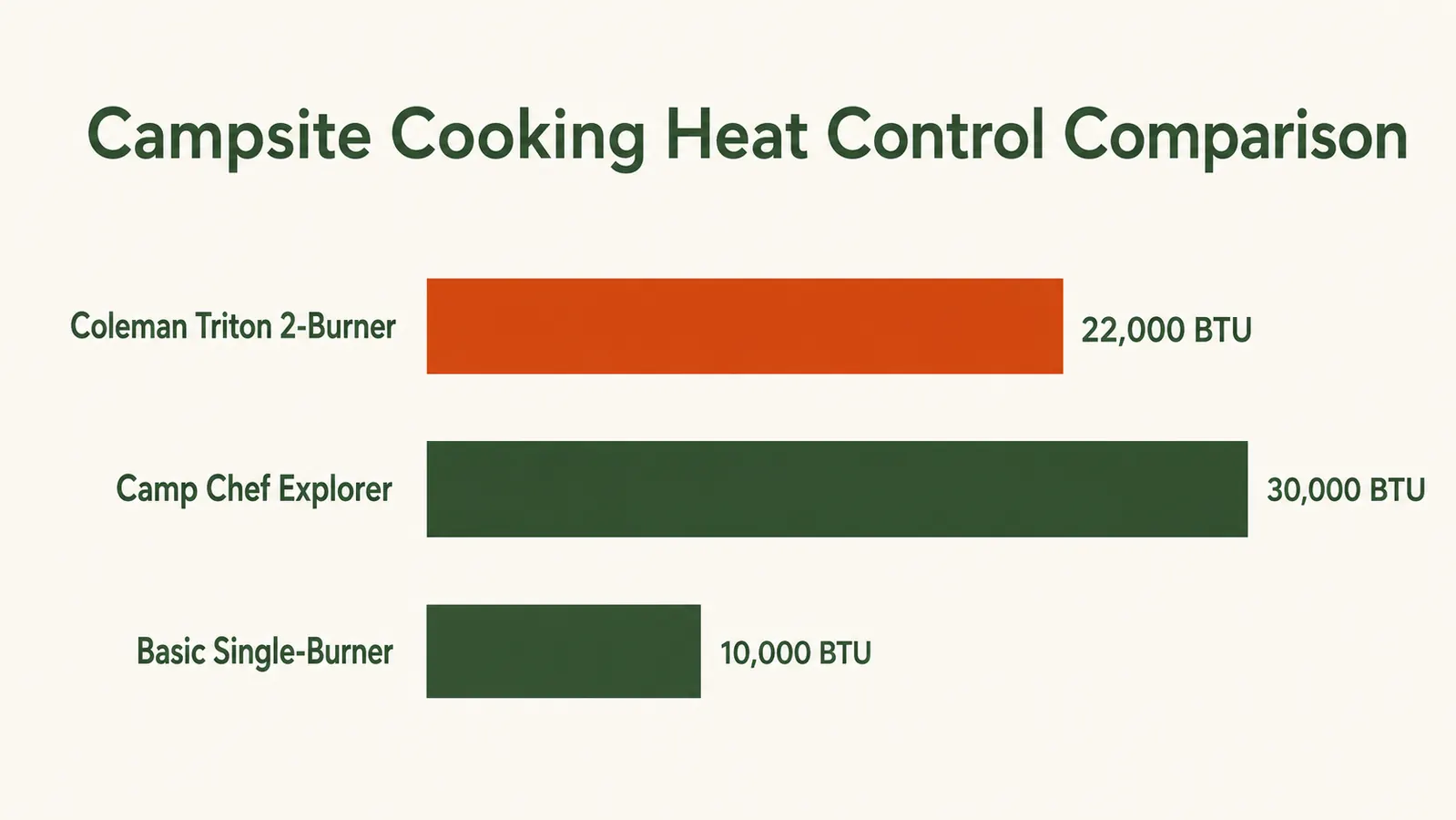
I also used it for dinner cooking on longer trips, including a stir-fry over high heat one evening that came out better than anything I had ever managed over a fire. The Triton puts out 10,000 BTU per burner, which is real heat, not 'adequate for boiling water' heat.

Heat Control and BTU Output
The 10,000 BTU per burner number matters in practice. That is enough to maintain a proper sear on meat, bring water to a boil in a reasonable amount of time, and actually fry things rather than steam them. Some budget 2-burner stoves advertise similar numbers but run inconsistently. The Triton has been consistent for me across three full seasons.
The control knobs give you a usable range from very low to very high. I have held a simmer on tomato sauce at a temperature that would not scorch the bottom, which is a harder ask than most camping stoves can handle. I have also cranked it to full open to get a wok-style high-heat cook on cast iron. Both work.
One thing to know: at high altitude, propane pressure drops and you will notice some output reduction. This is true of any propane stove and is not specific to the Triton. At 9,000 feet, I have boiled water fine but the high-heat sear became more of a medium-high. Plan accordingly if you are heading into the mountains.
Two independent burners sounds obvious until you have spent seasons without them. It changes how you cook outside.
Wind Panel Performance
The built-in wind panels on the Triton are a genuine feature, not a marketing bullet point. They fold out from the sides and back of the stove and create a three-sided shield around the burners. On calm days you will not notice them. On a 15 mph afternoon in the North Cascades, they kept both burners running at full flame while the trees around camp were swaying.
They are not impenetrable. A direct gusting crosswind can still knock a flame down if you catch it at the wrong angle. But compared to cooking on a bare stove top or over fire on a windy morning, the wind panels are the difference between getting breakfast done and fighting your gear for an hour. I have come to consider them a deal-breaker feature when evaluating camp stoves.
Build Quality and Portability
The stove is steel construction with a porcelain-coated cooking surface. The porcelain chips if you bang it hard enough, which has happened to me twice over three years of use. Both chips are small and the stove functions identically. Coleman sells this stove in the sub-$120 range and the build reflects that, but it is not flimsy. The latch that holds it closed during transport feels secure and has not loosened up on me.
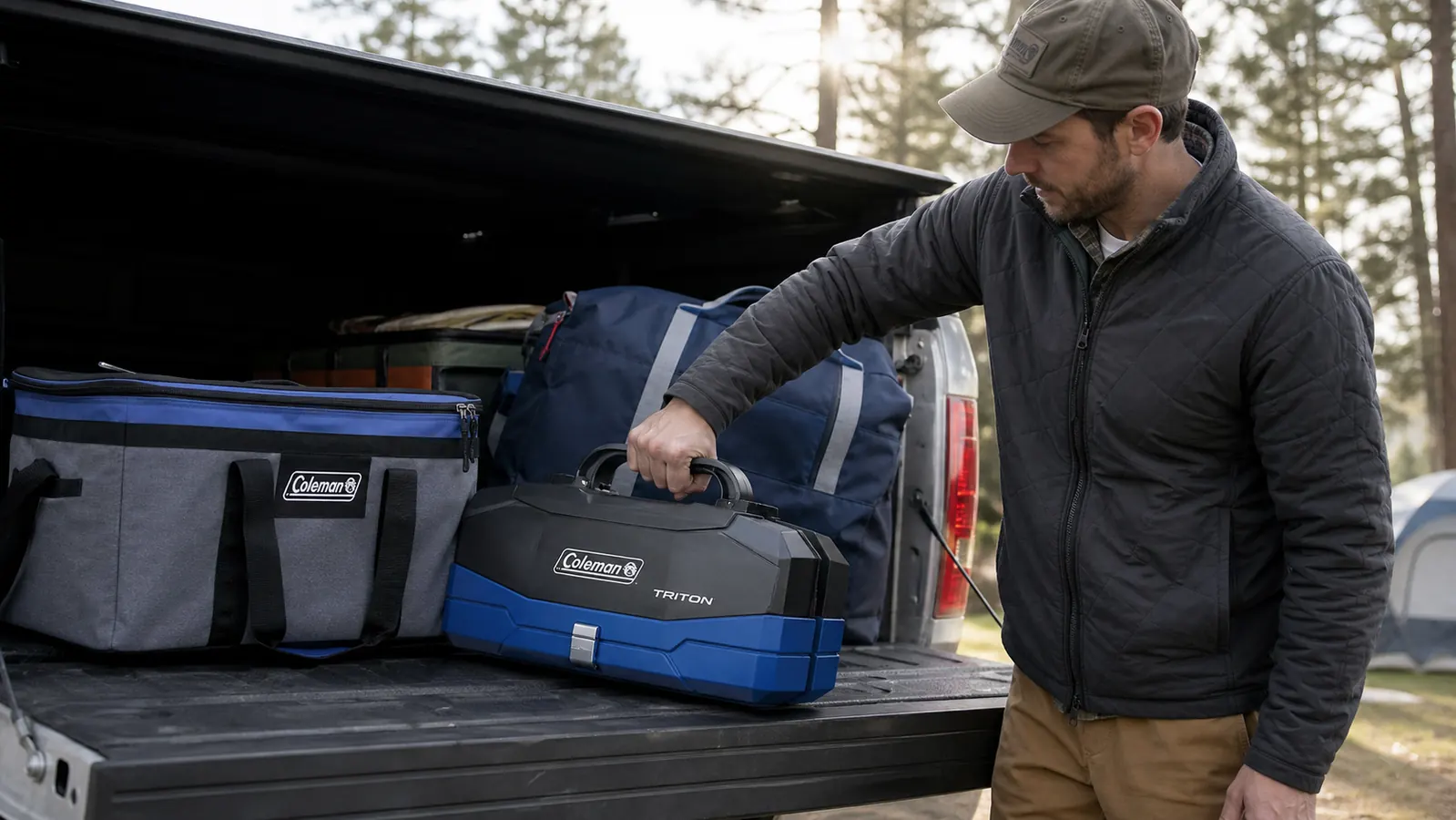
Weight is around 11 pounds, which sounds heavy until you remember it is a car camping stove. You drive it to the campsite. If you are a backpacker looking for a lightweight cooking setup, this is not your product. If you are loading a trunk or truck bed, 11 pounds is a non-issue. It folds down to a footprint that fits in most camp bags or can be strapped to the outside of a pack.
The legs flip out and lock, which gives it a stable, level cooking surface. I have cooked on uneven picnic tables and the stove has not rocked or shifted. The hose connection for the propane canister is standard and works with both 1-lb canisters and a bulk tank adapter, which is worth knowing if you camp frequently and want to save money on fuel.
Ignition System
The Triton has push-button ignition on each burner. It works most of the time. On cold mornings below about 45 degrees, the igniter can be stubborn and occasionally takes three or four attempts. This is a propane behavior issue as much as an igniter issue, but worth knowing. I carry a long-neck lighter in my camp kit as backup and have used it maybe four or five times over three years.
The igniter has not degraded noticeably over three seasons of regular use, which is better than some camp stoves I have owned where the spark system became unreliable by year two. If it does eventually fail, a lighter solves the problem. It is not a core reliability concern.
Fuel Efficiency
A standard 1-lb propane canister runs the Triton for roughly three to four hours of active cooking depending on heat setting. On a typical weekend trip where I am cooking two meals per day for three to four people, I go through about one and a half to two canisters over a two-night trip. I now bring three as my baseline and have never run out.
If you camp more than a few weekends per year, a bulk propane tank with an adapter hose pays for itself quickly. The per-BTU cost of bulk propane versus 1-lb canisters is significantly lower. The Triton accepts a standard adapter, and the switch takes about two minutes the first time.
What I Liked
- 10,000 BTU per burner delivers real, usable heat for actual cooking, not just boiling water
- Wind panels provide genuine protection and keep flames stable in moderate wind
- Two fully independent burners with wide adjustment range from simmer to sear
- Sturdy folding legs and stable footprint on uneven surfaces
- Works with both 1-lb canisters and bulk tank adapter
- Igniter has held up over three full seasons without degrading
Where It Falls Short
- Porcelain cooking surface chips with rough handling, purely cosmetic but worth noting
- Push-button igniter can be slow on cold mornings below 45 degrees
- At 11 lbs, not relevant for backpacking or any weight-sensitive kit
- Wind panels do not seal the front, so a direct headwind can still affect the flame
- No built-in pot support beyond the grates, which can shift slightly with heavy cast iron
How It Compares to Camp Chef and Other Alternatives
The Camp Chef Explorer 2-Burner is the stove people compare the Triton to most often. The Camp Chef runs higher BTU output (30,000 BTU total versus 20,000 for the Triton) and has better pot support. It also costs roughly twice as much and is heavier, with a larger footprint. For the weekend car camper cooking normal camp meals, the Triton's 10,000 BTU per burner is enough. If you are cooking for large groups or doing serious outdoor cooking where high heat matters continuously, the Camp Chef justifies its price.
On the cheaper end, there are a handful of no-name 2-burner stoves in the $40 to $60 range. I have used two of them. The BTU output is inconsistent, the wind protection is minimal, and both developed igniter problems within a season. The Triton's price is not low, but it reflects something real.
Who This Is For
The Coleman Triton is a good fit for the weekend car camper who wants to cook actual food at the campsite, not just boil water for freeze-dried meals. If you are feeding two to four people, cooking standard camp meals like eggs and bacon, pasta, stir-fry, or anything requiring two heat zones at once, this stove handles it. It is also a reasonable buy for car camping families who want a stove that does not require a lot of fuss to get working.
It works well for people who camp in variable weather and have been frustrated by stoves that quit in wind. The wind panels are a legitimate differentiator in that context. If you are in the PNW, the Rockies, or anywhere else where afternoon wind is a reliable part of the camping experience, the wind protection matters.
Who Should Skip It
If you are backpacking, this is obviously not your stove. If you primarily camp at sites with electrical hookups and use an induction plate or electric burner, you do not need it. If you are cooking for large groups, eight or more people regularly, consider the Camp Chef Explorer or a three-burner setup instead. The Triton can stretch to feed a crowd in a pinch, but it was designed for smaller groups.
If you are an occasional camper who goes out once a year and usually defaults to fire cooking or sandwiches, this stove may sit in a garage more than it gets used. A single-burner canister stove at a fraction of the cost might serve you better. I always say: match the gear to how you actually camp, not how you imagine you will camp.
If you are car camping more than twice a year, the Coleman Triton pays for itself in skipped frustration. Two burners, wind protection, consistent heat.
Over 3,500 reviews on Amazon and a 4.7-star rating that has held across multiple buying seasons. Check today's price and see current availability.
Amazon Check Today's Price on Amazon →